The Effect of a Discount in an Online Game: Why a 20% Sale Would Not Pay Off and How to Estimate It Without an A/B Test
An online shooter case: why a blanket 20% discount on time-limited items would have cut revenue and how to estimate it without an A/B test.
In short
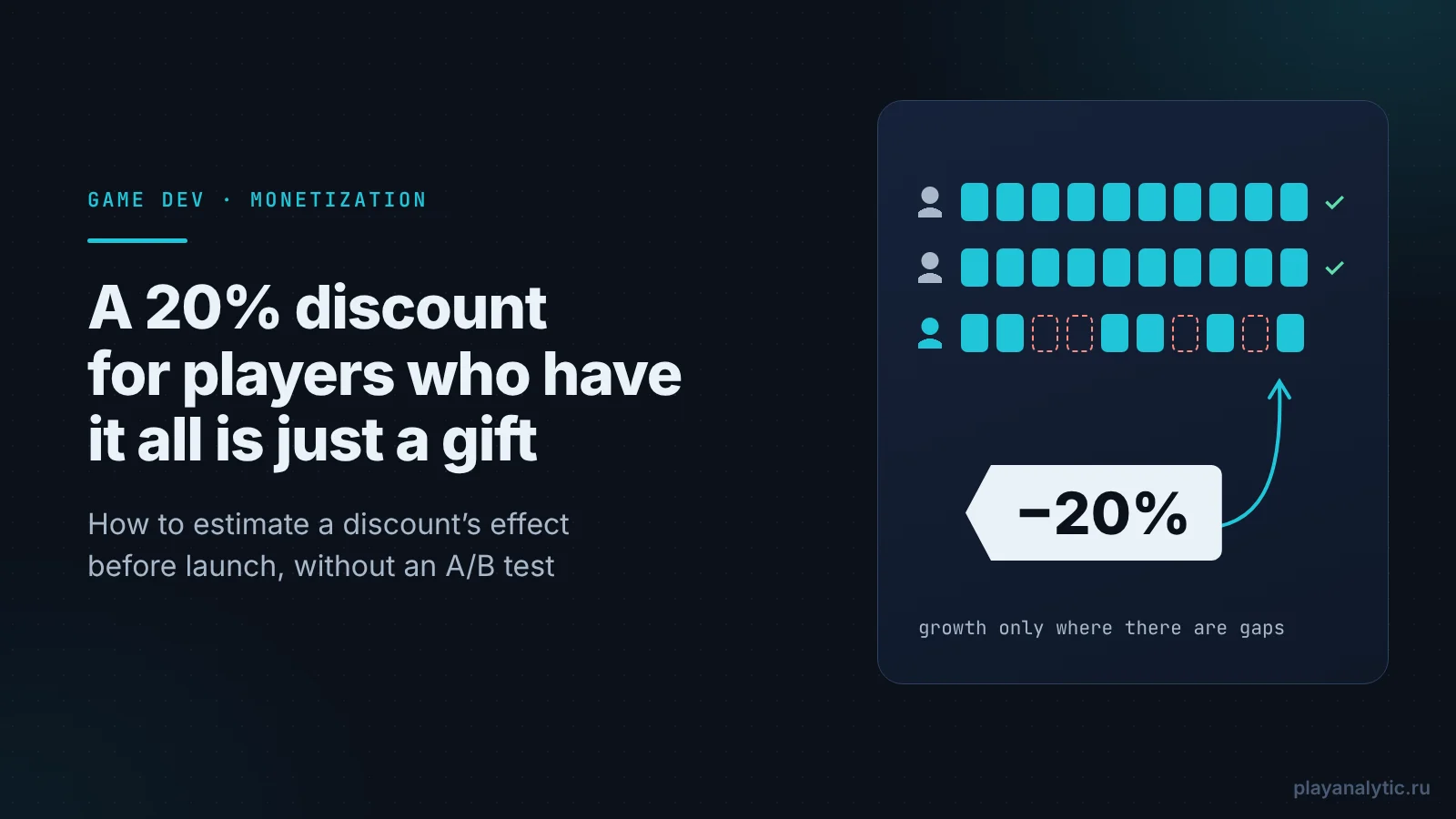
- A 20% discount pays off only if sales grow by at least 25%. For time-limited items that is often impossible: a player won’t buy two boosters at once or cover more days than they actually play.
- In our calculation on data from an online shooter, 50–60% of players in popular slots had already covered all their play days. A blanket discount took revenue from these items down by about 3%.
- The real value of such items is retention. So a discount is useful when targeted: at new buyers and collection slots. Below is how to calculate it and six questions to ask before any sale.
How much sales growth a discount needs to pay off
The product team of an online shooter we worked with wanted to run a blanket 20% discount on all time-limited items: weapons, XP boosters, cosmetics and combat bonuses for 1, 7 or 30 days. The usual logic: cheaper means people buy more.
Let’s check the math. At 20% off, each sale brings in 80% of the old price. To keep revenue flat, sales have to grow by 25% (1 / 0.8 = 1.25).
| Discount | Sales growth needed to keep revenue flat |
|---|---|
| 10% | +11% |
| 20% | +25% |
| 30% | +43% |
| 50% | +100% |
The deeper the discount, the faster the bar rises. And the key question is not “will it be cheaper” but “can a customer buy a quarter more”.
Why a discount doesn’t work for products with a ceiling
Time-limited items have a ceiling. An item occupies its slot: when the timer runs out, the slot is empty and you need to buy again. Nobody needs two XP boosters at once, and you can’t cover a slot for more days than you play.
If a player already keeps the item active every day they log in, a discount won’t make them play more. They will buy the same amount, just cheaper. It’s like a discount on a subscription for people who are already subscribed.
The same principle applies outside games: subscriptions, plans with limits, memberships, consumables with a clear usage rate. Wherever a customer has a ceiling, a blanket discount mostly gives money away to people who already pay.
How to estimate the effect of a discount without an A/B test
A price test in an online game is a risky move: players talk, and different prices for the same item quickly cause discontent. So we started with the data the publisher already had.
The data was imperfect, as it almost always is: item stockpiles were not visible, and it was not always clear whether an item was bought or received from a loot box or a battle pass level. So we counted play days, not items.
- Grouped items by slot. We got about twenty slots: weapons, gear, XP booster, cosmetics, combat bonuses. Items within a slot compete with each other.
- Calculated coverage. For each player and slot, what share of their play days was covered by paid days.
- Split players into 8 segments by how often they play and their coverage, and assumed a demand uplift for each.
- Recalculated each slot’s revenue for seven months as if the discount had been running all that time.
| Who | Coverage of play days | Assumed demand uplift |
|---|---|---|
| Play often (15+ days a month) | all days | 0%, only the discount loss |
| 70% or more | +10% (buy 2–3 extra days) | |
| 30–70% | +50% | |
| under 30% | +80% | |
| Play rarely (under 15 days) | all days | +30% |
| 70% or more | +20% | |
| 30–70% | +15% | |
| under 30% | +25% |
The coefficients are expert estimates and deliberately generous: we assumed growth even for fully covered players who play rarely. And everything we couldn’t account for works against the discount: items from loot boxes and the battle pass only increase real coverage.
What to do in your product: find the unit in which the product has a ceiling (days, a limit, a slot) and calculate what share of buyers has already hit it. This is faster and cheaper than a test and immediately shows whether the discount stands a chance. If you want to check a sale or another decision before launch, that is what our pre-launch check is for.
What the calculation showed: the discount loses money
- About −3% of revenue from time-limited items, even with the assumed demand uplift.
- 50–60% of players in popular slots had already covered all their play days.
- More than half of the slots went negative, and they account for almost 80% of direct-purchase revenue.
- −7% to −11% in slots where 70–90% of the money comes from fully covered players.
- About +6% for weapons: there it makes sense to collect several variants, and “saturated” players bring only about 40% of revenue.
- Under 1% of total game revenue lost in the end, because direct purchases are only 20–30% of revenue; the rest comes through bundles, loot boxes and the battle pass.
Losing under one percent doesn’t sound scary. But this is money the publisher would have handed to its most loyal players for what they were already doing. And the estimate is an optimistic one.
Where a discount really pays off: retention
Time-limited items work not for revenue in the moment but for retention. You can see it by comparing their buyers with other players (averages over seven months):
| Buyers of time-limited items | vs. everyone who doesn’t buy them | vs. payers who don’t buy them |
|---|---|---|
| Log in | 2.5 times more often | almost 1.5 times more often |
| Time in game | 4–5 times more | 2 times more |
| Average spend | — | 2 times higher |
The key metric is churn: about 30% of buyers didn’t come back the following month, versus 60% of everyone else. And almost all paying players buy these items.
So the value of a discount is not making the core buy more, but getting new players to start buying. We modelled that scenario too: if 20% of those who had never bought started buying with a modest spend and were retained like current buyers, over seven months that would add about 3% to game revenue. That is more than the loss from a blanket discount.
Our recommendation:
- don’t run a blanket discount: it hands money to the core who already pay;
- offer targeted discounts on collection slots and for those who haven’t bought yet;
- judge these items by retention and activity, not by sale-week revenue.
The blanket discount was not launched. Targeted ones haven’t been run yet either, so the second part of the recommendation hasn’t been tested in practice. We look at how a game’s economy works and where its growth points are in game economy analytics.
What this calculation does not prove
- Comparing buyers and non-buyers is not an experiment. Those who buy already play more, so “about 3%” is an upper estimate, not a promise.
- The 20% conversion and the demand coefficients are assumptions. The model is built so you can change them and see the result right away.
- Counting by paid days is an approximation. Stockpiles and item sources are not visible in the data.
That is enough for the decision: even with assumptions in the discount’s favour, the blanket sale didn’t pay off. The exact effect of targeted discounts on retention will be shown by a small, cheap experiment. How to design it so you can trust the result is covered under A/B testing.
Six questions to ask before a discount in your game
- Does the item have a ceiling? A time limit, a slot, a per-character cap. If a second copy isn’t needed, a discount for saturated players is just a gift.
- What share of the money has already hit the ceiling? Calculate play-day coverage by slot. In our case, slots where 70% or more of revenue came from fully covered players lost 7–11%.
- How much do you need to sell on top? A 20% discount needs +25% sales, 30% needs +43%, 50% needs +100%. Compare that with how much players with gaps can realistically buy.
- What part of revenue will the discount touch? And where else do players get the same items: loot boxes, bundles, the battle pass. The more free sources, the less room for extra purchases.
- Who actually needs the discount? Players with gaps, collection slots, people who have never bought. A blanket discount only partly reaches them.
- Which metric will you judge success by? If the item works for retention, look at churn and activity the following month. And agree in advance what result you will call a failure.
A discount is the price you pay to change behaviour. If behaviour has nowhere to go, you’re just paying.
If you have a sale or promotion coming up and have doubts, tell us about it: in a free 30-minute review we’ll suggest which data to look at before launch.
FAQ
How do I know whether a discount will pay off?
Compare how many extra sales you need with how much customers can actually buy on top. A 20% discount needs +25% sales, 30% needs +43%, 50% needs +100%. If the product has a ceiling (a time limit, a slot, a cap) and most buyers have already hit it, the discount will simply reduce revenue.
Can you estimate the effect of a discount without an A/B test?
Yes, if you have purchase and activity history. Calculate how much of their need each buyer has already covered, split the audience into segments, assume a cautious demand uplift for each and recalculate past revenue as if the discount had already been running. A price test comes later and only where the calculation shows potential.
Why do online games avoid price A/B tests?
Players talk to each other, so different prices for the same item quickly become visible and cause discontent in the community. A price test also costs money and weeks. That is why it pays to get the most out of the data you already have first.
When does a discount in a game actually work?
When players have room to grow: in slots where collecting matters (several weapons), among players with gaps and among those who have never bought. Such discounts should be judged by retention and activity the following month, not only by sale-week revenue.