Reliable ETL/ELT Pipelines: Build for Detection, Recovery and Trust
How to build resilient data pipelines with contracts, idempotent processing, quality checks, actionable alerts and safe historical replay.
Key takeaways
- Pipeline success must be measured by the data delivered, not only by process completion.
- Data contracts make expectations about schema, grain, keys, timing and ownership explicit.
- Idempotency, run metadata and replay procedures make retries and historical recovery safe.
- Alerts should identify the affected business products, the severity and the person responsible for the next action.
- Reliability controls should be prioritised by business impact, starting with the datasets used in critical decisions.
A pipeline can be green in the scheduler and still deliver a broken dataset. A source may return only part of a page, an event may be sent twice, or a field may change type without warning. The failure becomes visible only when a business user questions a number. Reliable ETL/ELT engineering therefore needs more than retries and job-status alerts. It needs a clear contract with each source, observable data quality and a recovery process that protects downstream decisions.
What should a reliable data pipeline promise?
A reliable pipeline promises that a defined dataset will be available at an agreed time, with known completeness and quality conditions. This promise should be specific enough to test and realistic enough to operate.
A nightly job that completes successfully does not prove that all source pages were fetched. A streaming consumer may be running while its offset stops advancing. A schema change may add a field that silently breaks a downstream calculation. These are delivery failures even if no exception appears in the orchestration log.
Define service expectations for each critical flow. They may include freshness, completeness, valid schema, duplicate tolerance, reconciliation and recovery time. The exact thresholds should follow the consuming process. An executive revenue view may require a clear “not ready” state before a meeting; an exploratory dataset may tolerate a longer delay.
Separate the service expectation from the implementation. The business owner needs to know what they can rely on. Engineers need to know what to monitor, how to detect failure and which recovery steps are permitted. A useful service-level objective links the two without pretending that every dataset needs the same availability target.
How do data contracts prevent avoidable failures?
A data contract records what a producer promises to deliver and what consumers are allowed to expect. It reduces the risk that an upstream change will silently alter a downstream model.
A practical contract covers dataset purpose, grain, primary or natural keys, field types, required fields, accepted values, event-time semantics, timezone, refresh cadence, expected delay and the owner to contact when something changes. It should also describe how additions, removals and breaking changes are announced.
Technical checks validate structure and delivery. They can detect a missing column, an incompatible type, an absent partition or a delayed file. Semantic checks validate the business meaning: a payment has an accepted currency, a status belongs to the known domain, and a record references a valid entity where the model requires it.
Not every deviation should stop every pipeline. Classify checks by severity. A missing currency on a financial transaction may make the dataset unsafe to publish. A new optional product category may be routed for review while unaffected data continues. The data owner should approve the distinction because technical teams cannot determine the business impact in isolation.
Contracts need versioning and ownership. If the source team changes its event definition, the consumer should know whether it is a compatible addition or a semantic break. A shared document that nobody updates is not a working contract.
How should retries and reprocessing work?
Retries are safe only when the processing logic can handle the same input more than once without creating unintended side effects. That is the practical purpose of idempotency.
For event data, use a stable event identifier or a documented composite key to identify duplicates. For periodic snapshots, define whether a partition is replaced, merged or versioned. For changing entities, specify how updates and deletions are applied. The correct pattern depends on the source behaviour and the history consumers need.
Store run metadata such as start and end time, source window, record counts, checksums where available, code version, status and failure reason. This makes it possible to determine what completed and what needs to be replayed. Keep enough source history to investigate a defect and reproduce a transformation when policy allows it.
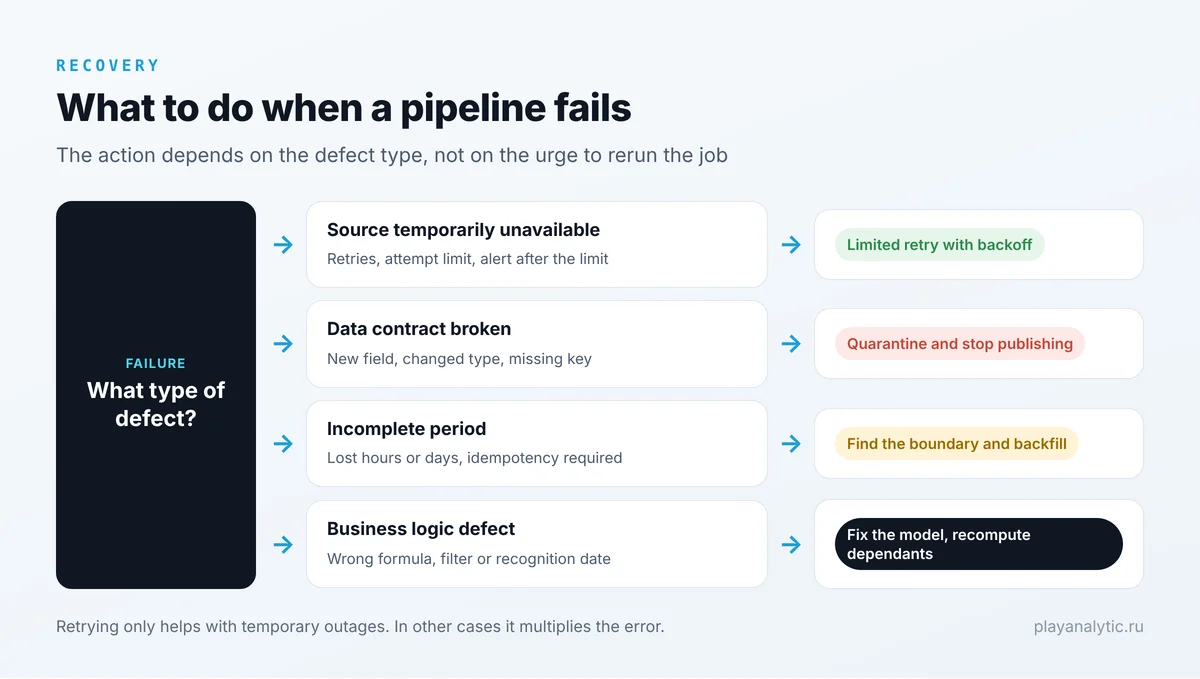
A backfill is not simply rerunning yesterday’s job for an old date. It may affect dependent models, aggregates and reports. Before a large replay, estimate resource use, identify downstream tables, define the order of execution and communicate whether current data will be temporarily unavailable. Test the recovery on a bounded period first.
Use bounded retries for transient failures such as a temporary network interruption. Do not repeatedly retry a deterministic schema error or invalid business value. After the retry limit, move the task into a clear failed or quarantined state and send an actionable alert.
What should pipeline monitoring make visible?
Monitoring should connect engineering signals to downstream business impact. “Task failed” is useful to an engineer, but a reporting owner also needs to know which dataset is stale, which dashboard is affected and whether an alternative source is available.
A monitoring model usually covers four dimensions. Execution includes job status, duration, frequency and retry patterns. Delivery includes freshness, record volume, partition coverage and lag. Quality includes duplicates, nulls, invalid values, schema drift and reconciliation. Impact maps datasets to models, reports and users.
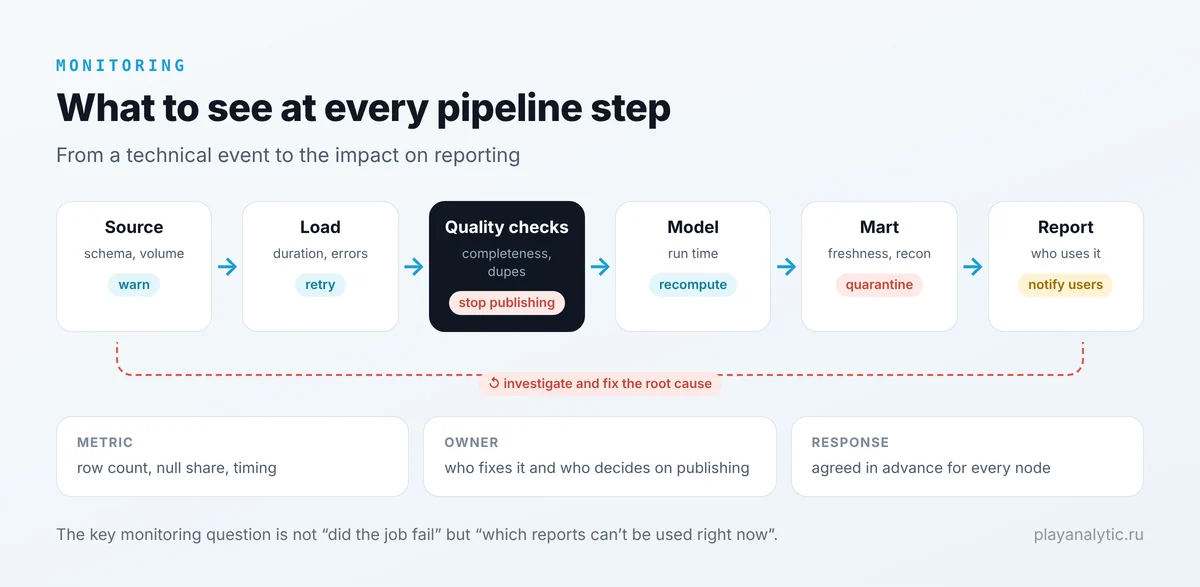
Define incident severity in business terms. A critical incident may block a board-level report or an operational decision that cannot be delayed. A medium incident may affect one mart while a safe alternative remains. A low-severity issue may require planned correction but not an immediate interruption. ## How should teams manage a data incident?
Incident response should be documented before a failure occurs. For each critical flow, identify who confirms the issue, who can pause publication, who fixes the source or transformation, who approves replay and who communicates with consumers.
A practical sequence is:
- Contain the impact by pausing publication or marking the dataset as incomplete.
- Identify the affected source, time range, partitions, transformations and downstream consumers.
- Preserve evidence such as logs, schema versions, run parameters and control totals.
- Correct the underlying issue and test the change on a limited sample.
- Replay the affected period and rebuild dependent models in the correct order.
- Reconcile the recovered result and notify users that the dataset is safe again.
- Add a preventive control or improve detection so the same failure is less likely to recur.
A post-incident review should ask why the issue escaped detection, whether ownership was clear, whether the recovery procedure worked and whether the source contract needs to change. The goal is to improve the system, not to assign blame. Repeated manual fixes are a sign that the root cause remains unresolved.
Which controls belong in a release checklist?
A short release checklist makes operational expectations visible before a pipeline is considered production-ready.
| Control | Review question | Evidence to retain |
|---|---|---|
| Schema | Are breaking changes detected? | Versioned contract and validation result |
| Completeness | How do we know the period is complete? | Partition or source control totals |
| Uniqueness | Can a replay create duplicates? | Stable key and deduplication rule |
| Freshness | When is data considered late? | Agreed window and alert rule |
| Recovery | Can an older period be rebuilt? | Tested backfill procedure |
| Dependencies | Which products use this dataset? | Lineage or dependency map |
| Ownership | Who decides whether to publish? | Named owner and escalation path |
The checklist does not replace security review, performance testing or disaster recovery. It prevents common operating questions from being postponed until after users depend on the data.
How should reliability work be prioritised in an existing stack?
Start by ranking pipelines according to the decisions they support and the consequences of failure. A stream that feeds finance, billing or a live operational process deserves stronger controls than a rarely used exploratory dataset.
For each critical flow, check whether there is an owner, a freshness expectation, a completeness test, safe retry behaviour, run history, a recovery procedure and a map of consumers. This review often reveals improvements that do not require changing the orchestration tool or warehouse.
Introduce controls incrementally. First establish source contracts and a small number of critical checks. Then improve alert routing and downstream impact mapping. Add historical replay and incident reviews for flows where recovery matters. Standardise tooling only when the number of pipelines and teams makes local practices hard to govern.
We design data platforms, ETL/ELT pipelines, data marts and BI, and hand over documentation, monitoring rules and a support model along with the code. If your pipelines already run but errors still reach reports, start with anomaly monitoring and the checklist in Data anomaly or data error?. The overall layer design is covered in DWH architecture: from data sources to BI.
FAQ
Is streaming more reliable than batch processing?
Not by default. Streaming can reduce latency, but it introduces continuous operations, event ordering and replay considerations. If the business makes decisions once a day, a well-controlled batch process may be simpler and more reliable. Choose based on the consumer's actual timing requirement.
Should every data-quality failure stop publication?
No. Block publication when the defect makes the dataset unsafe for its intended use. Other issues may be quarantined, marked as warnings or isolated to affected records. The rule should be agreed with the metric or data owner.
How often should quality tests run?
Critical delivery checks should run with each relevant load or update. Trend and anomaly checks may need a longer history and a separate schedule. Frequency should reflect the risk, freshness target and cost of detecting a defect late.
Can a pipeline be guaranteed to never fail?
No realistic architecture can promise zero failures. The goal is to detect problems quickly, limit their impact, restore trusted data and reduce recurrence. Clear expectations and measured incident performance are more useful than an absolute guarantee.