DWH Architecture: Design a Warehouse That Can Evolve
A practical guide to warehouse domains, data grain, history, transformation patterns, data marts and architecture trade-offs.
Key takeaways
- Start with business domains and decisions, then determine the data model and platform requirements.
- Define grain, keys, history and ownership before building marts. These choices are harder to repair after reports depend on them.
- Keep source history, integrated entities and business-facing models conceptually distinct, even if some layers share physical infrastructure.
- ETL and ELT are design choices based on privacy, latency, compute economics and team capability, not a maturity ladder.
- A thin vertical release is a better architecture test than loading many sources with no clear consumer.
A warehouse is tested not by the number of tables it contains, but by how well it supports new questions without making every change expensive. The design needs to preserve source meaning, business history and shared definitions while allowing teams to build useful views for different domains. The central architecture challenge is to create enough structure for trust and reuse without turning a data platform into a system that only its original authors can maintain.
How should business domains shape a warehouse?
Business domains provide a practical way to organise ownership and meaning. Finance, orders, customers, marketing, product usage and operations often have different source systems and different rules, but they need to connect through agreed entities and measures.
Begin by listing the questions that cross these domains. A profitability view may need orders, refunds, product costs and customer segments. A retention analysis may need acquisition source, product events, subscription status and support interactions. These use cases reveal which entities must be integrated and where definitions need an owner.
Avoid designing the entire warehouse around the current reporting hierarchy. Departments change, and one business entity may be relevant to several domains. A customer model, for example, may be used by finance, marketing and product, but each domain may need different attributes and access rights. Establish shared identity rules while allowing subject-specific models to serve different workflows.
Domain ownership is as important as the technical schema. Name the person or function responsible for source meaning, business rules and change approval. Data Engineering can implement a model, but it should not be expected to decide whether a cancelled order belongs in a commercial KPI or how finance recognises revenue.
What must be decided about grain, keys and history?
Grain is the business meaning of one row. It should be stated in plain language before a table is created, because an unclear grain causes duplicate counts and misleading aggregations.
A sales fact table might contain one row per order, one per order line or one per payment event. These are not interchangeable. Joining an order-level amount to several order lines can multiply revenue unless the model accounts for the different grains. Document the grain next to the model and test that its key behaves as expected.
Business keys and warehouse identifiers serve different purposes. A customer ID from a CRM can change after a migration, and multiple systems may refer to the same person or organisation differently. Define the identity resolution rules, confidence levels and treatment of uncertain matches. Do not silently merge records when the evidence is weak.
History is another explicit design choice. Overwriting a customer’s current status is sufficient for some operational uses, but it cannot answer what the status was when a contract was signed. Depending on the question, preserve event history, dated snapshots or validity intervals for changing attributes. Make late-arriving corrections and deletions part of the model rather than an afterthought.
Which layers belong in a maintainable DWH?
A useful logical architecture separates ingestion, preservation, integration and consumption. The physical implementation can be simpler, but each responsibility should remain understandable.
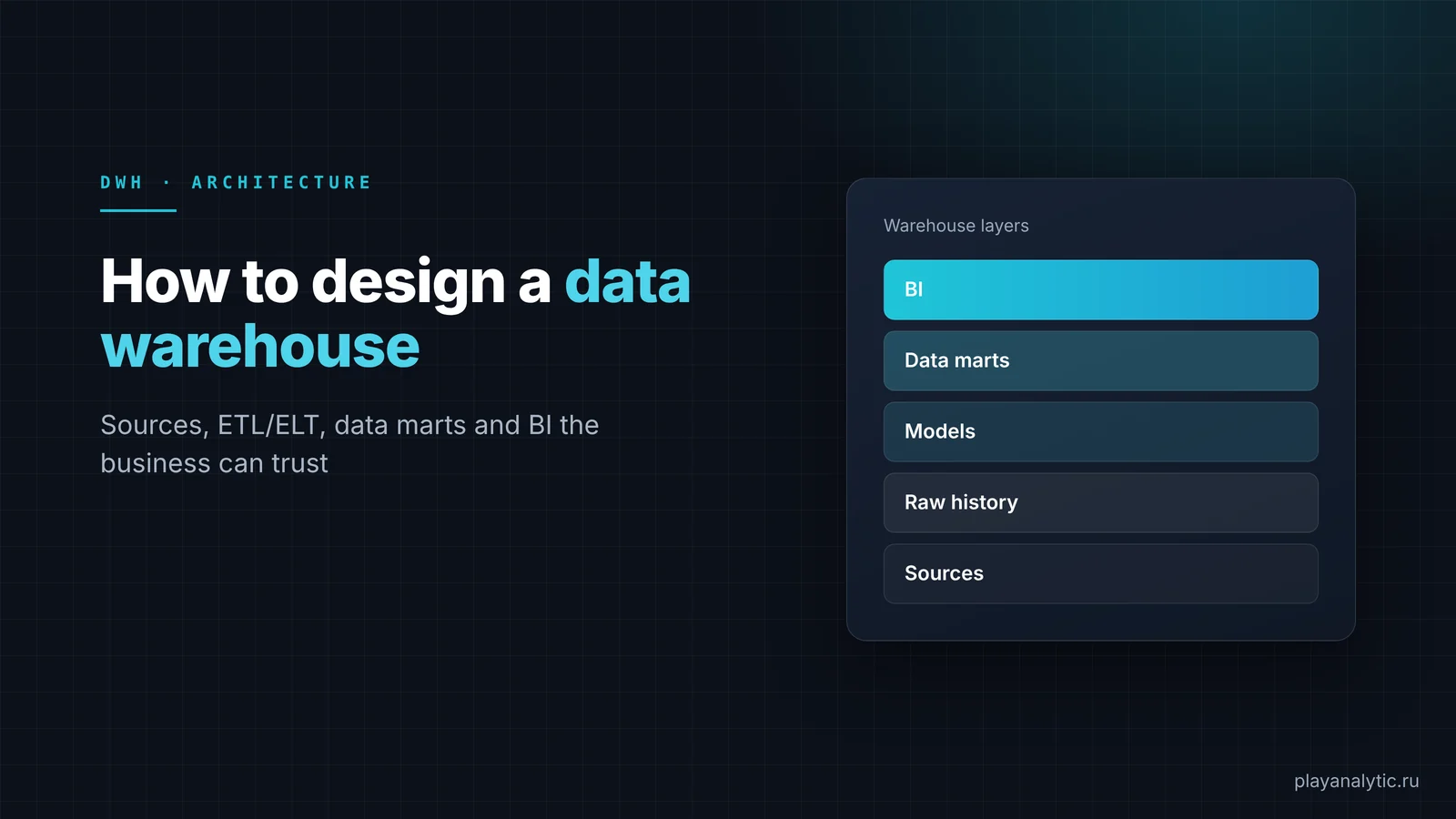
A typical flow contains source systems; ingestion jobs; a raw or landing area; integrated models that standardise keys and business rules; data marts for subject areas; and a semantic or BI layer for metrics and access. The raw layer helps replay transformations and investigate source changes. Integrated models reduce repeated logic. Marts organise information around consumer needs.
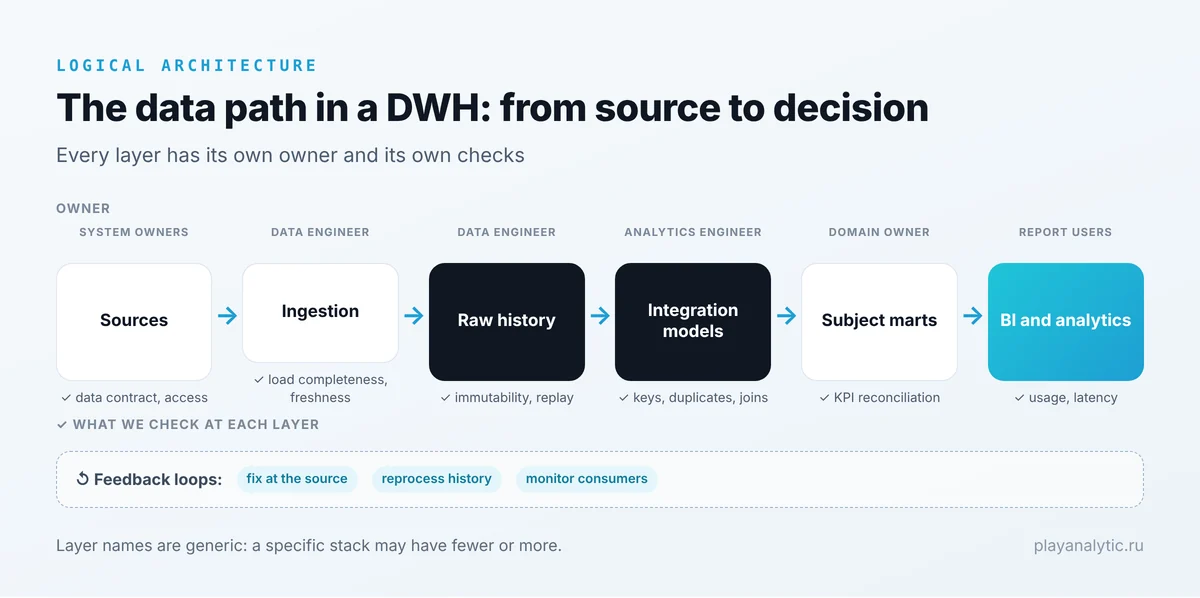
This structure is not a requirement to deploy a different database for every layer. A small team may keep several logical layers in one warehouse. What matters is that a developer can distinguish source-faithful data from transformed business logic and from report-specific presentation rules.
Do not create a generic “enterprise model” that attempts to represent every possible future question. Overly abstract models delay delivery and are hard to validate. Equally, do not place all business logic in dashboard calculations. The appropriate middle ground is a small set of governed shared entities plus focused marts for real use cases.
How should ETL and ELT fit into the design?
ETL transforms data before loading it into the target environment; ELT loads data first and performs transformations within the target platform. Neither is automatically cheaper, safer or more modern.
ETL may be suitable when sensitive fields must be filtered before transfer, transformations need to run in a controlled environment or the destination should receive a reduced dataset. ELT can be effective when the warehouse has suitable compute, teams need to retain source history and transformations are developed collaboratively within the platform.
Choose per data flow where necessary. Consider latency, volume, source limits, privacy, compute cost, replay requirements and the team’s operational skills. A single organisation may reasonably use batch ELT for finance data and a different ingestion pattern for product events.
The key test is reproducibility. Can the team identify which version of a rule produced a metric, rerun a historical period safely and explain a change in a KPI? If the answer is no, the architecture needs stronger controls regardless of whether the transformation is labelled ETL or ELT.
How can the first release prove the design is sound?
Build a thin vertical slice around one decision. It should include a representative source, ingestion, an integrated model, a useful mart and a report or downstream consumer. This reveals whether the architecture works as an operating system rather than a collection of disconnected technical components.
Imagine a retailer combining marketplace orders with an ERP and an order-management system. Before building the sales mart, agree how to treat cancelled orders, refunds, marketplace fees, taxes and the date on which a sale belongs to a reporting period. Reconcile a representative period against the finance system and investigate differences by transaction type.
Acceptance should cover meaning and operations. Check row grain, key uniqueness, late-arriving updates, freshness, access permissions, lineage and expected query performance. Ask an intended user to complete the decision task without manual spreadsheet repair. A dashboard that looks correct but relies on an undocumented filter is not an accepted data product. Use this release gate:
- Grain and keys are documented.
- History and late updates are tested.
- Each critical dataset has an owner and freshness target.
- Reprocessing and access controls are verified.
- A named user completes the decision without spreadsheet repair.
How should architecture balance cost and complexity?
Total cost of ownership includes more than platform fees. It includes engineering time, monitoring, support, retention, backup, security, incident response and the effort required to add or change sources.
Compare options using realistic workloads. Estimate routine compute, storage growth, concurrency, data transfer, specialist skills and migration costs. Treat uncertain figures as ranges and validate them in a pilot. A design that is inexpensive in a demo may be costly when it requires specialist support or frequent reprocessing.
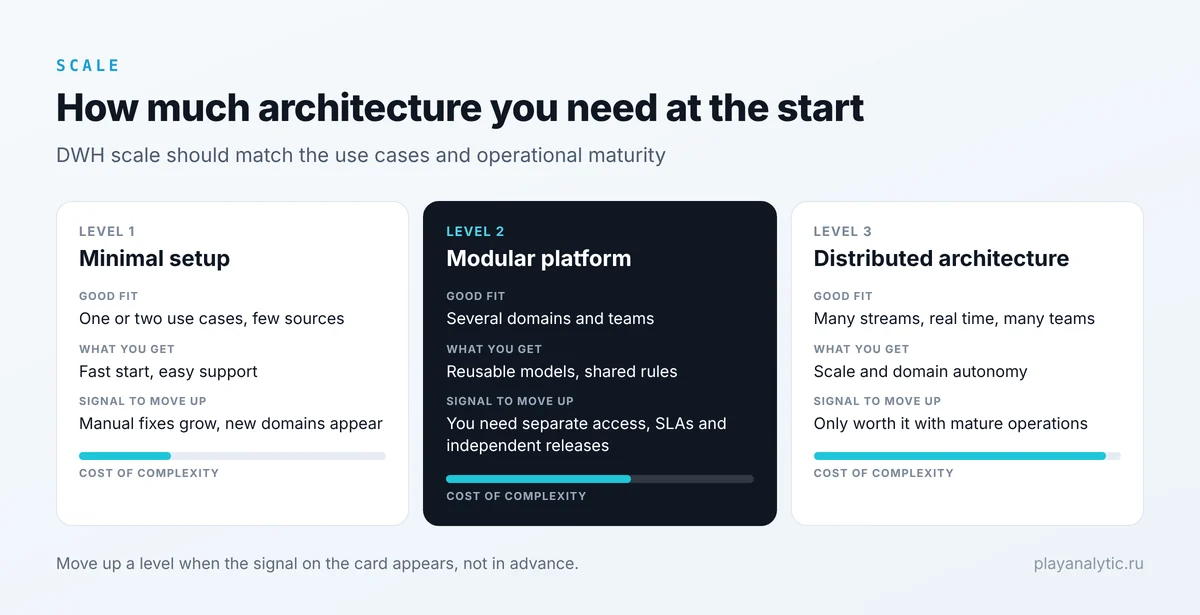
Avoid both extremes. A highly distributed design may introduce services and dependencies that the team cannot operate. A single collection of scripts and dashboard queries may be fast to launch but hard to test, audit or reuse. The right architecture is the simplest one that meets business, risk and operational requirements with room to evolve.
What makes a warehouse sustainable for the team?
A warehouse is sustainable when its models have owners, changes are reviewed and the team can recover a critical flow without depending on one person’s memory. Documentation is not a separate project; it is part of delivery.
For each critical dataset, document its purpose, grain, keys, source, refresh expectation, quality checks, owner and consumers. Keep transformation code in a controlled repository, use review for business logic and maintain a release process. Agree how breaking source changes are communicated and how downstream consumers will be notified.
A handover should include architecture decisions, operational runbooks and known limitations. A data platform provider can build a useful foundation, but the client needs the knowledge and access to support it afterward.
We design the warehouse, connect sources, build data marts and BI, and hand the result over to your team with documentation. In one of our projects the warehouse combined marketplace, ERP, order and CRM data, and revenue and cost marts matched the accounting system within 0.2% (case study). That is the result of a specific project, not a promise for every architecture. More about the service: turnkey data warehouse and BI.
FAQ
When does a company need a dedicated data warehouse?
The signal is recurring cross-system use, not a specific number of sources. A warehouse becomes useful when several teams need consistent history and shared definitions, manual consolidation is becoming risky, or changes to one system repeatedly break reporting. A single stable report may not justify a separate platform.
Should we choose a cloud warehouse before modelling?
Not necessarily. Establish security, residency, latency, workload, skills and cost requirements first. Then test candidate platforms with a representative use case. Vendor popularity is not a substitute for fit.
Can analysts build and maintain a DWH without data engineers?
A small environment may be manageable by technically strong analysts, provided operational ownership is explicit. As source count, reliability requirements and model complexity grow, dedicated engineering skills become more important. Someone must own deployment, monitoring and recovery regardless of team title.
How often should the architecture be reviewed?
Review it when meaningful conditions change: new domains, higher volume, latency expectations, security requirements, cost pressure or recurring operational failures. A periodic dependency review is useful, but architecture work should be triggered by evidence rather than a calendar ritual.