Proof of Value in Analytics: Turn a Data Idea Into an Investment Decision
How to frame an analytics value hypothesis, establish a baseline, choose an evaluation design and make a scale, refine or stop decision.
Key takeaways
- A PoV tests business value, not just technical feasibility or the quality of a prototype.
- The use case needs a decision owner, a real user, a baseline and a measurable outcome.
- Evaluation rules should be agreed before results are visible.
- Data readiness and workflow adoption matter as much as model performance.
- A well-run PoV can produce a justified stop decision, which is a valuable way to avoid a larger investment.
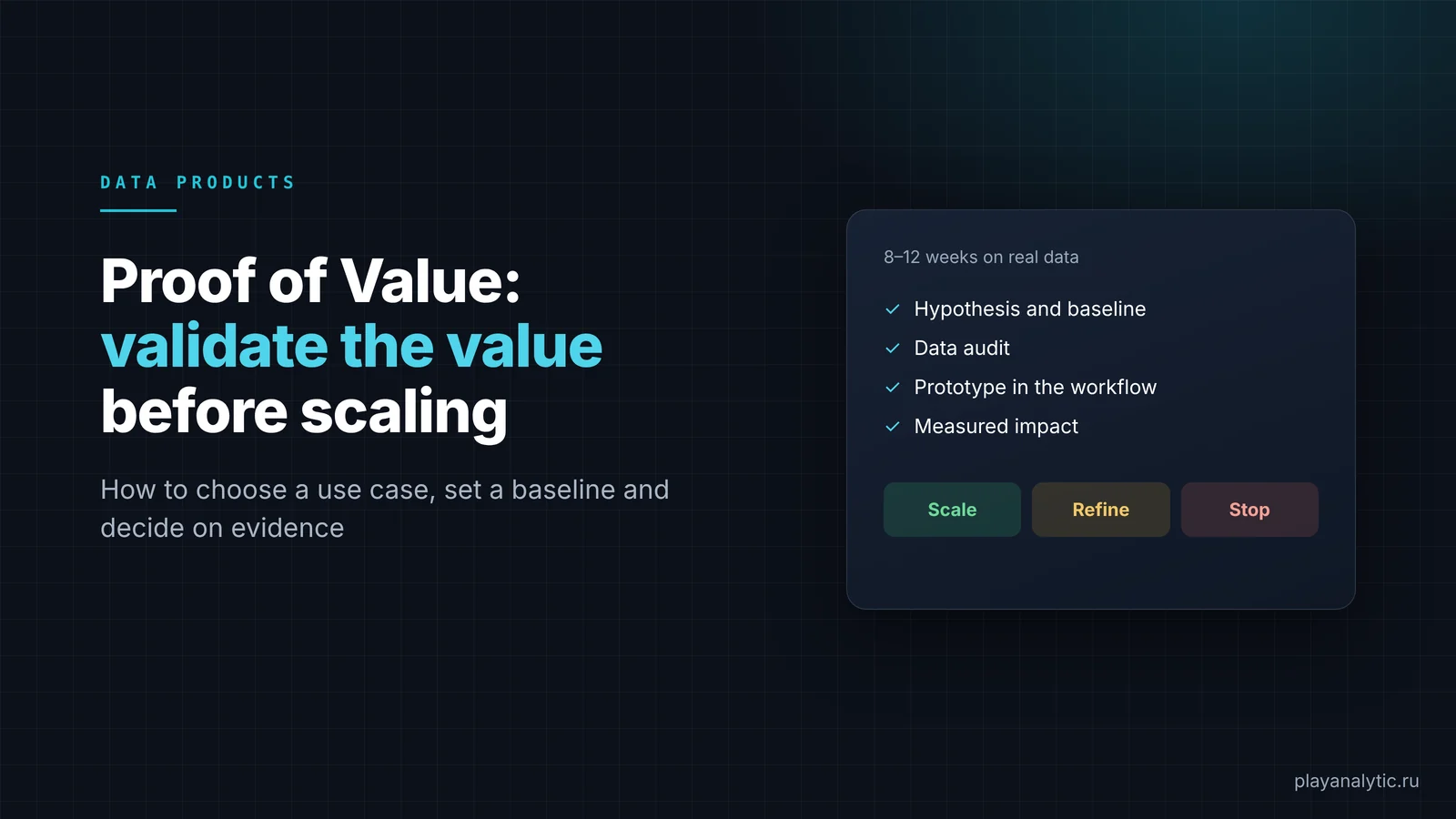
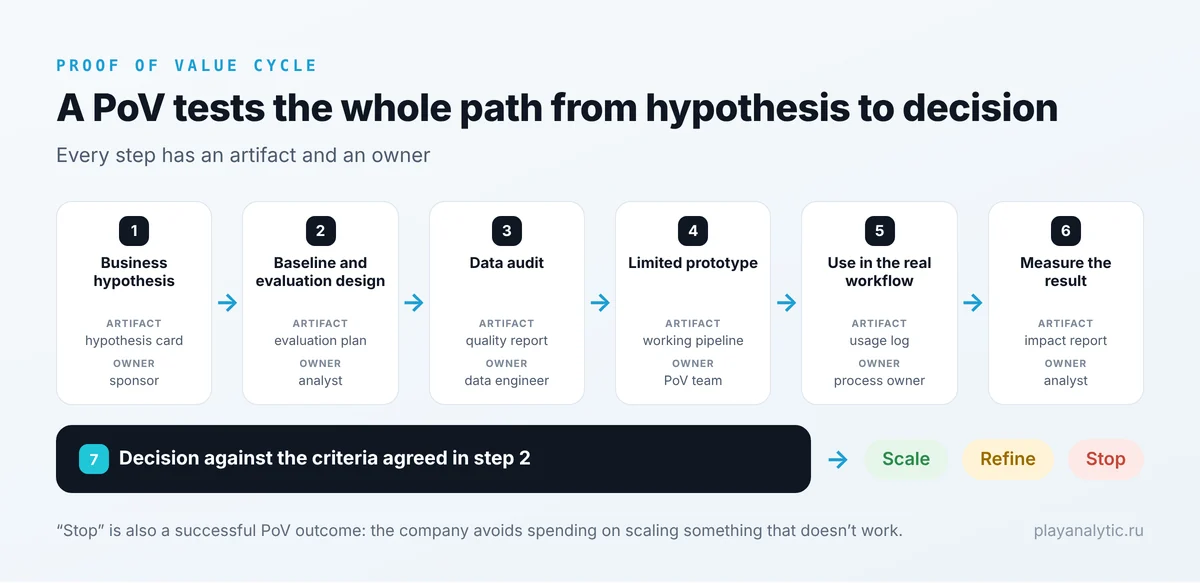
A successful demo can prove that a team can build a model or connect a data source. It does not prove that the result will improve a business process. Proof of Value (PoV) is a structured way to test that missing link before the organisation commits to a wider rollout. It should help leaders make one of three decisions with evidence: scale the solution, refine a specific part or stop the initiative.
What does a Proof of Value actually validate?
A Proof of Concept typically asks whether something can be built. A Proof of Value asks whether it can improve a business outcome under realistic conditions. Consider a churn model. A technical demo may show acceptable performance on historical data. A PoV must go further: who receives the score, what action do they take, how is the result observed and what would have happened under the existing process? Without those answers, model accuracy is not proof of business value.
A complete PoV examines three layers. Technical feasibility covers data access, quality, integration and performance. Operational feasibility tests whether users can receive and act on the output in time. Business value asks whether the decision or process improves against a baseline. Failure at any layer can make a rollout inappropriate, even when the model itself performs well.
How should a use case be selected?
A good use case describes a specific decision, the person responsible for it, the population affected and an observable outcome. “Use AI to improve operations” is too broad to evaluate.
Start with a current workflow. Who makes the decision today? What information do they use? How frequently does the situation occur? What is difficult or costly about the current approach? Then state a testable hypothesis. For example: “Providing a demand forecast to planners before order submission will reduce stockouts in the selected product group without creating an unacceptable increase in excess inventory.”
Assign a business owner before starting. The analytics team can design the method and produce evidence, but a process owner must confirm that the action is possible and that someone will use the result. Without an accountable user, the PoV is likely to become a technical prototype with no path into operations.
How should the baseline and success criteria be defined?
The baseline describes the current process before the intervention. It should be measured and documented before the team sees the desired result, otherwise the comparison can be changed to fit the outcome.
Choose baseline measures that match the use case. For a manual reporting task, this may include preparation time, number of corrections and time to answer a recurring question. For a prioritisation model, it may be the quality of the current selection process. For a recommendation workflow, it may be the observed behaviour of a comparable population under existing rules.
Set success criteria across several dimensions. Technical criteria may cover data completeness or model performance. Operational criteria may cover delivery before a decision deadline and user adoption. Business criteria may cover time saved, reduced error exposure or a change in a relevant outcome. Set thresholds according to the cost of error and value of the decision, not a generic benchmark.
Define guardrails as well. A solution that reduces processing time but increases customer complaints or creates unacceptable risk is not a success. Depending on the context, guardrails may include service quality, margin, fairness, security, employee workload or player experience.
Which evaluation design can support a credible conclusion?
The strength of the conclusion depends on how the result is compared with the baseline. A randomised experiment can provide strong causal evidence when it is feasible and ethically appropriate. When it is not, a matched comparison, time-series analysis or before-and-after design may be useful, but its assumptions must be explicit.
Define the unit of analysis first: customer, transaction, branch, employee, product or time period. Then specify the observation window, inclusion rules, seasonality and external factors. If groups are compared, check whether they were similar before the intervention. If the evaluation uses a historical comparison, document other changes that occurred at the same time, such as pricing, staffing, marketing or policy.
Imagine a support team introducing an assistant that suggests responses. The number of closed tickets may rise because fewer complex tickets arrived during the test period, not because the assistant helped. Review ticket mix, waiting time, reopen rate and customer feedback alongside throughput. Report uncertainty and limitations rather than a single uplift figure.
If the available sample cannot distinguish a meaningful effect, say so. An inconclusive result is not proof that the solution has no value. The next decision may be to extend observation, change the design or stop because a reliable answer would cost too much to obtain.
How should data and workflow readiness be checked?
Data readiness means the organisation can access representative data and connect the proposed output to an observed result. The existence of a table is not enough.
Check missing values, stable identifiers, historical depth, event delays, schema changes, duplicates, timezones and selection bias. Ask whether the population represented in the data matches the people or processes that will use the solution. New markets, channels or user groups may be underrepresented in historical records.
Then walk through the user journey. Where will the result appear? Who interprets it? What action is available? What happens when confidence is low or the service is unavailable? Can the user override a recommendation and record why? These details determine whether the result can be adopted safely.
For high-impact decisions, a PoV may begin in “shadow mode”: the model produces recommendations, but people continue using the existing process. The team can compare the recommendation with actual decisions without giving the model uncontrolled authority. A later stage can test assisted use with agreed guardrails.
How should the scale decision be made?
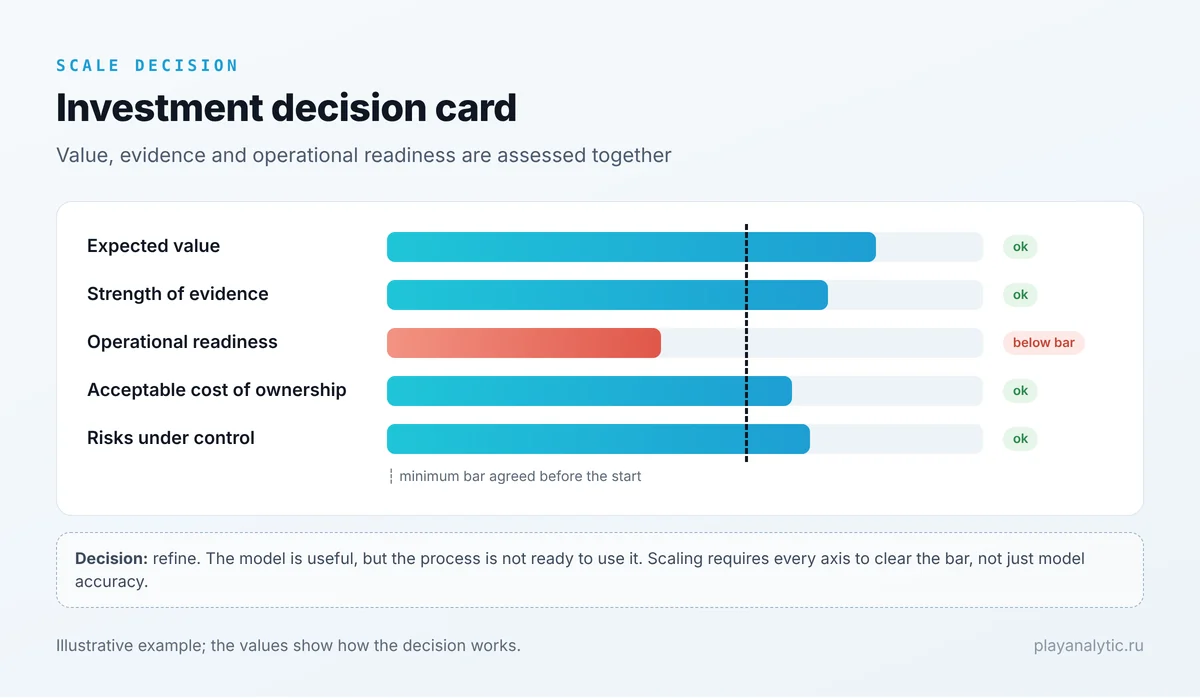
Scaling should depend on evidence quality, operational readiness, expected value and the cost of ongoing ownership. A successful limited test does not prove that the effect will persist across every business unit or customer segment.
Before expanding, examine performance across segments, data volume, infrastructure costs, integration dependencies, support needs and change management. Estimate the full cost of ownership, including monitoring, retraining or rule maintenance, user support, security and the work required when source systems change.
Choose to refine when a specific limitation is understood and can be addressed with a bounded next test. A model may work for one segment but lack representative history in another. A reporting product may answer the question but require clearer ownership or integration into an existing meeting. State what must change and what evidence will be collected next.
Stop when the core hypothesis is not supported, data cannot be used appropriately, the cost of error is too high or expected value does not justify the operating burden. Record what was tested and what new condition would make the question worth revisiting. A disciplined stop decision is preferable to scaling a solution because the team has already invested effort.
A practical PoV charter
A one-page charter aligns stakeholders and makes it harder to move the goalposts during delivery.
| Field | Question to answer |
|---|---|
| Business question | Which decision or workflow should improve? |
| Decision owner | Who is accountable for using the result? |
| User group | Who will see or act on the output? |
| Baseline | How does the process work today? |
| Hypothesis | What change is expected and why? |
| Evaluation method | Experiment, comparison group or another design? |
| Success criteria | Which outcomes and thresholds are agreed in advance? |
| Guardrails | What must not get worse? |
| Data readiness | Which sources, periods and limitations apply? |
| Final decision | Who chooses scale, refine or stop? |
If the final decision owner is missing, pause the work. A technically sound result can still become a presentation that no one is authorised to act on.
How can PlayAnalytic support a PoV?
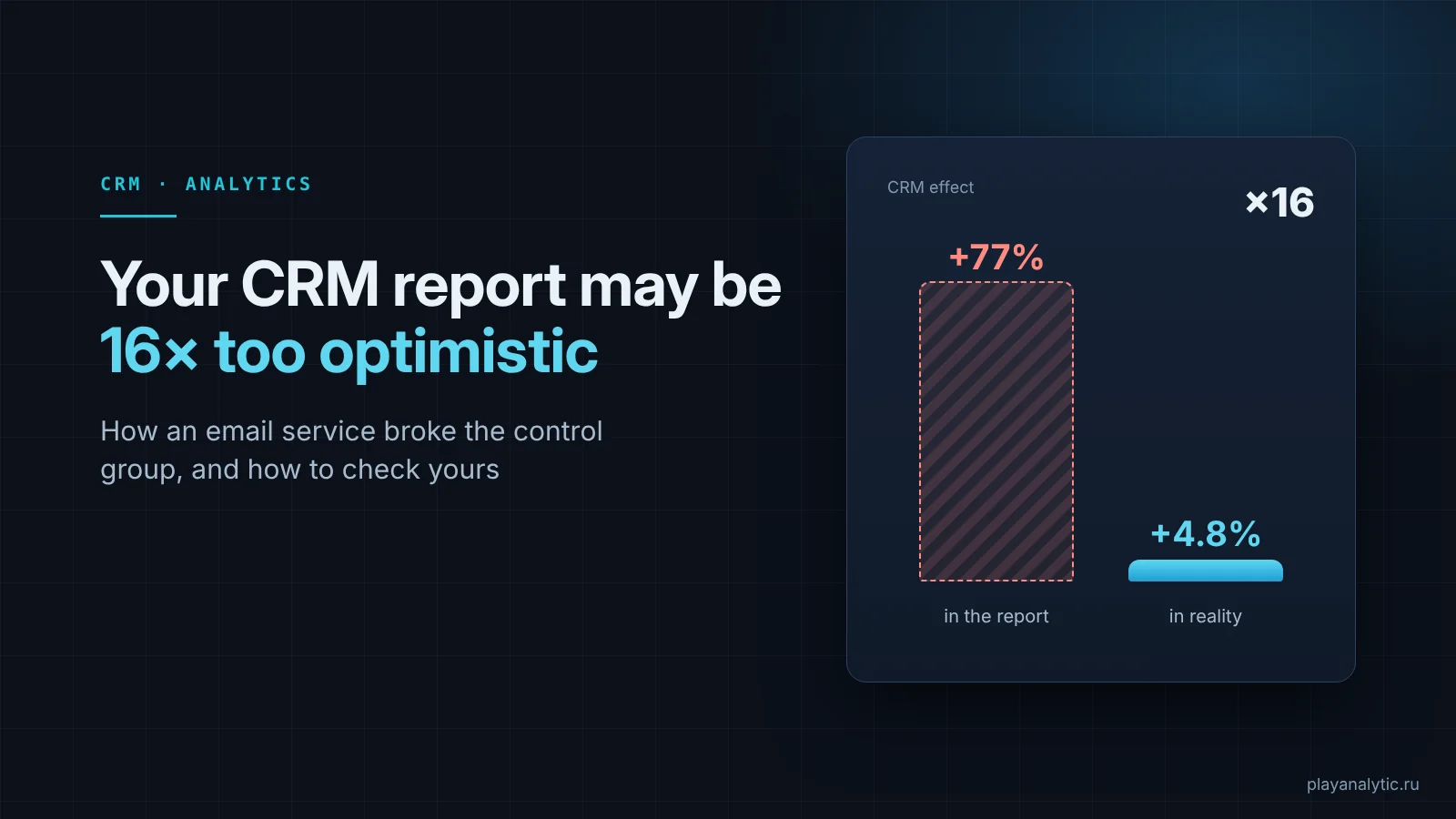
An external data team can help choose the use case, assess the source data, build a bounded data product, define evaluation measures and prepare a scale decision. In our Proof of Value format we test a data product on real data in 8–12 weeks: LTV and churn models, user-acquisition pipelines, live ops triggers, dashboards and A/B test design. The scope depends on the chosen use case, and the timeline applies to our format rather than to every PoV. How a flawed evaluation design can inflate an effect many times over is shown in our article on the CRM control group.
FAQ
How long should a Proof of Value take?
Long enough to test the main hypothesis with adequate data and observation. A short test may miss seasonality or infrequent events, while an open-ended project can expand beyond the decision it was meant to support. Timing should follow event frequency, evaluation design and data availability.
Does a PoV require machine learning?
No. It can validate a reporting layer, integration, analytical method, workflow or business hypothesis. If a simple rule solves the problem more cheaply and transparently than a model, that may be the better result.
What if there is no measurable baseline?
First look for historical records, operational logs or a sample that can reconstruct the current process. If no credible baseline exists, establish an observation period before introducing the change. The conclusion will be weaker without a comparison, and that limitation should be explicit.
Who should approve a rollout?
The business process owner should make the value decision with finance and technical stakeholders where their responsibilities are affected. Analytics provides the evidence and limitations, but should not decide alone whether the investment is justified.