Interim CDO: A Temporary Data Leader With a Clear Mandate
When interim data leadership makes sense, how to define the mandate and authority, and how to transfer a sustainable data function to the permanent team.
Key takeaways
- Interim data leadership is appropriate when several data priorities need coordination and no existing role has the mandate to own them.
- The role is broader than an analytics consultant and should connect business decisions, architecture, governance, budget and people.
- Decision rights, sponsorship and scope must be agreed before the engagement begins.
- A practical mandate produces visible operating artefacts, not only recommendations or status presentations.
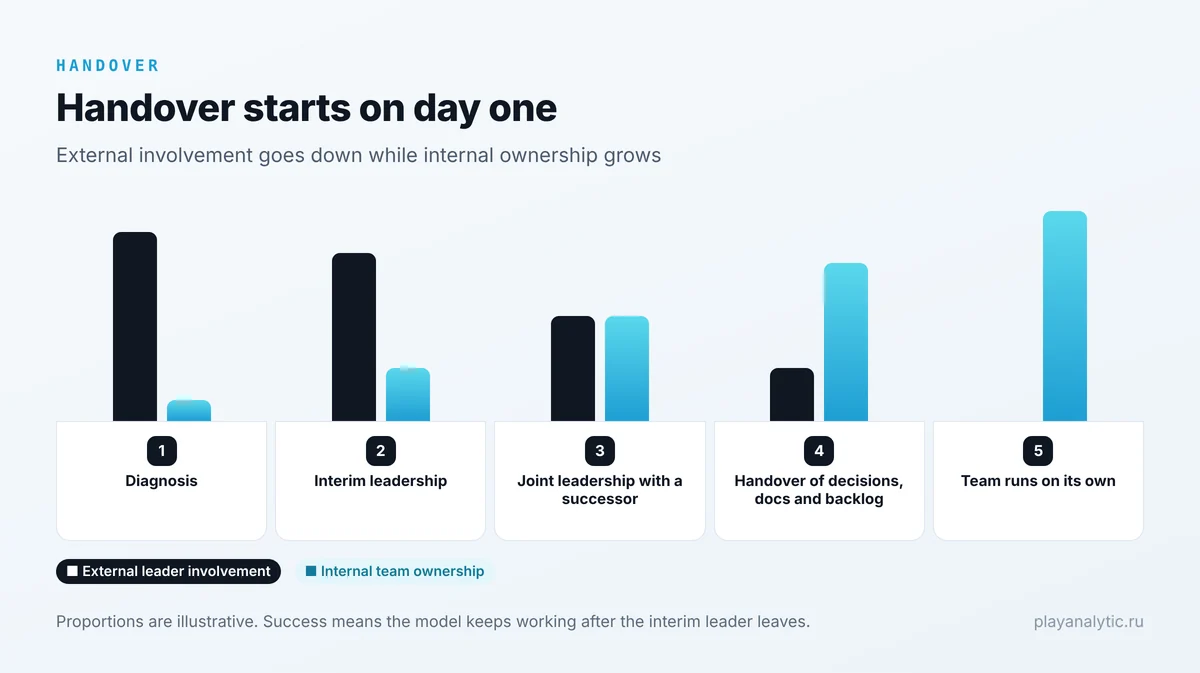
- Handover should be designed from day one, with internal owners developing throughout the engagement.
There is a point at which data becomes too important to manage between the responsibilities of a CTO, finance director or analytics manager. Yet not every company is ready to hire a permanent Chief Data Officer, and leadership gaps often appear at the moment a transformation needs direction. An Interim CDO provides temporary executive ownership across strategy, governance, teams and delivery. The engagement is successful when the organisation can keep making decisions after the interim leader leaves.
When does a company need interim data leadership?
An Interim CDO is useful when the business needs temporary ownership of a cross-functional data agenda. The trigger may be growth, an acquisition, a platform migration, a leadership departure, a stalled transformation or persistent disagreement about who controls important metrics.
Consider a company changing its warehouse while finance is redefining management measures and product teams are hiring analysts. Engineering can own the platform, finance can own accounting policy and product can own user behaviour. But no one may be responsible for sequencing the work, resolving competing priorities and explaining the investment to the executive team. An interim leader can provide that coordination.
The role is less useful when the need is narrow. A short architecture review, vendor comparison or metric workshop may be better served by specialist advice. It may also be unnecessary when a capable internal leader already has time, authority and support to run the agenda. Adding a temporary executive without clarifying the existing structure can create another approval layer.
The decision should start with a clear diagnosis: what important outcome is currently unmanaged, what prevents the existing team from owning it and what authority would be required to change the situation?
How is an Interim CDO different from a consultant or analytics lead?
The difference lies in the scope of accountability and the ability to coordinate decisions. A consultant advises on a defined question, an analytics lead manages analytical delivery, and an Interim CDO connects multiple functions within an agreed executive mandate.
| Role | Primary focus | Typical output | Main boundary |
|---|---|---|---|
| Specialist consultant | A specific problem or decision | Review, recommendation or design | Usually does not own the full delivery agenda |
| Head of Analytics | Analysis, reporting and analyst capability | Team priorities, research and reporting | May not control platform or cross-company governance |
| Data Engineering Lead | Data platform and engineering delivery | Pipelines, models and operations | Does not automatically own business semantics or investment priorities |
| Interim CDO | Strategy, governance, people and coordinated execution | Roadmap, decision model, budget options and team development | Effective only with sponsorship and real decision rights |
The boundaries vary by company size. In a small organisation, one person may cover several responsibilities temporarily. In a larger company, the CDO should work through domain owners rather than approve every technical task. The mandate should complement existing leaders, not compete with them.
What should the mandate and decision rights include?
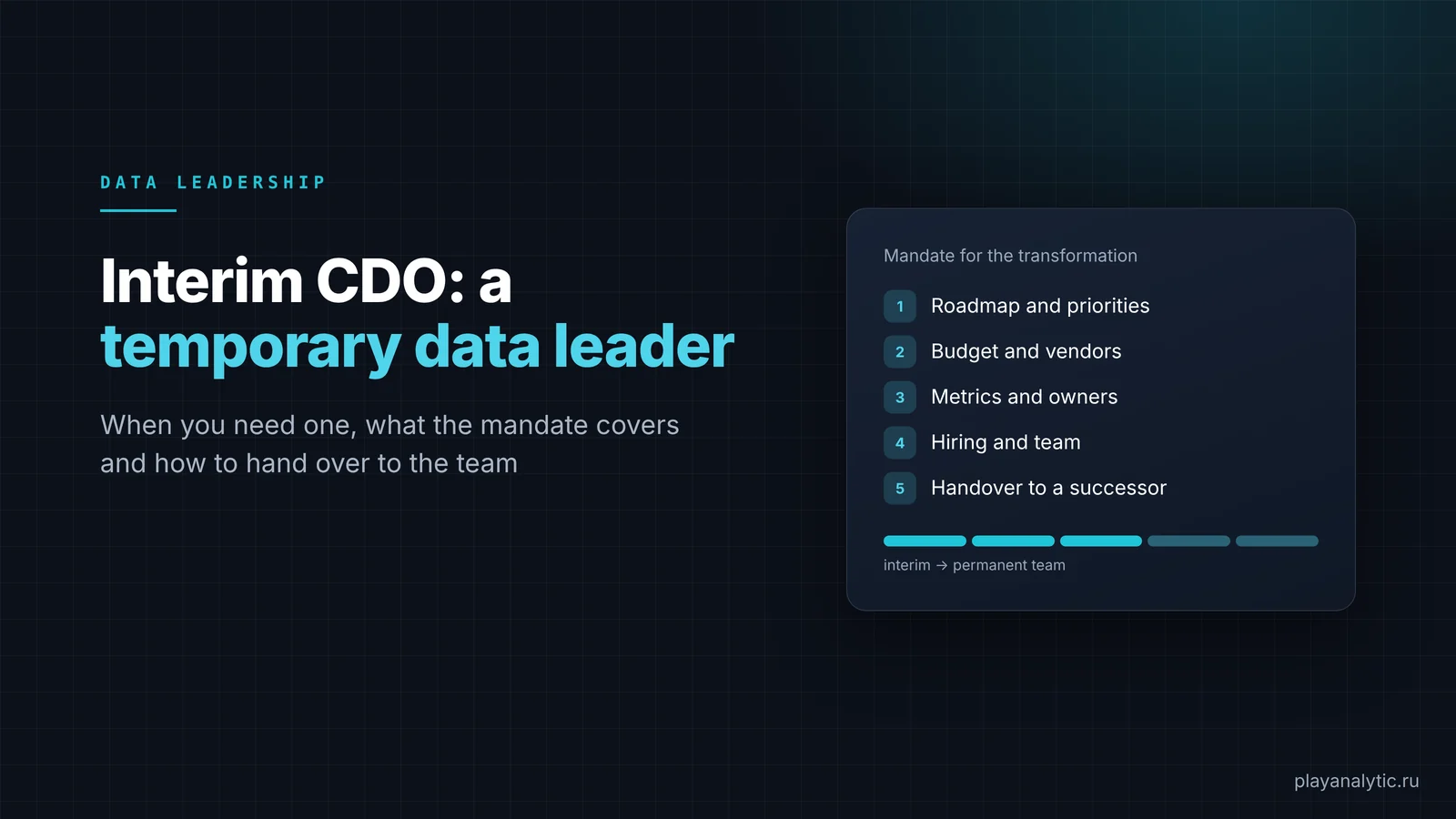
A mandate should state the business outcomes, areas of responsibility, decisions the interim leader can make and ownership that will remain after the engagement.
Define the scope explicitly. It may cover data strategy, architecture principles, portfolio prioritisation, governance, budget planning, vendor selection, recruitment and executive reporting. Not every engagement needs all of these. Record exclusions as well: for example, the Interim CDO may set architecture direction but not take over day-to-day IT operations.
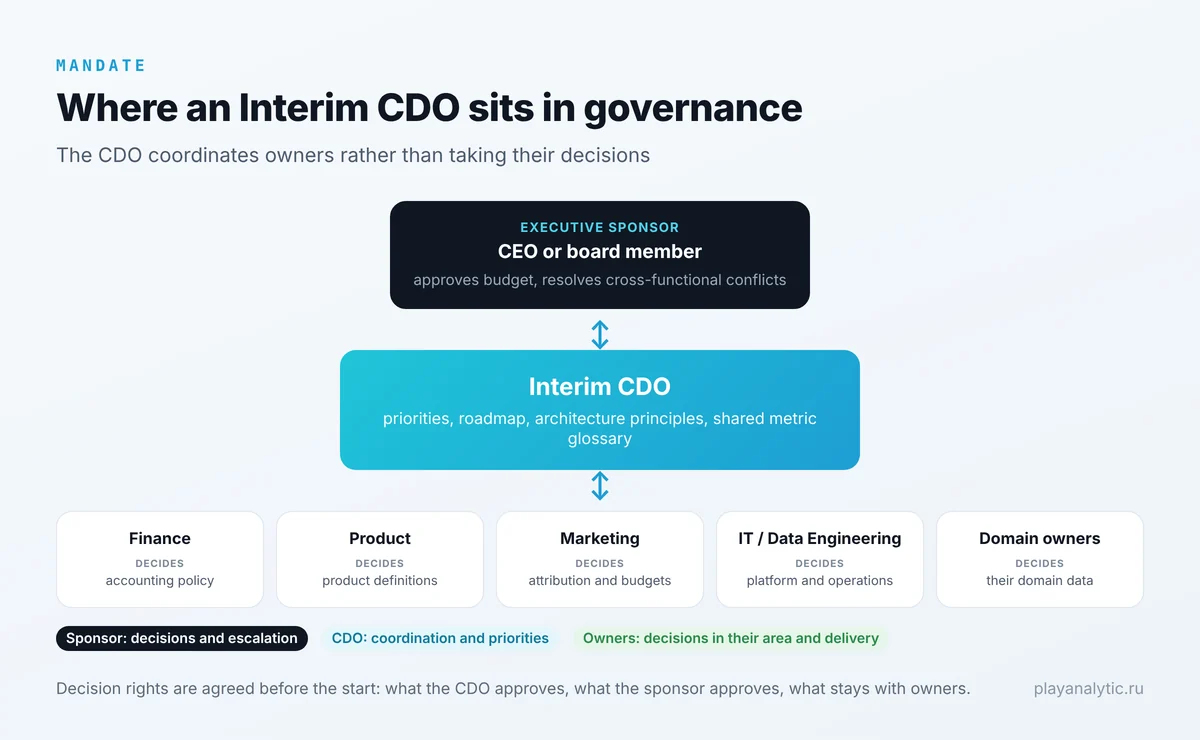
Set decision rights. The interim leader might approve priorities within an agreed budget, while the executive sponsor approves investment above a threshold. Finance retains responsibility for accounting policy. Product leaders own product definitions. The CDO makes cross-domain conflicts visible and ensures that changes follow a shared process.
The sponsor must be senior enough to resolve conflicts between functions. Agree on access to system owners, the meeting cadence, escalation routes and what evidence counts as progress. A title without the authority to convene stakeholders or influence priorities is not an effective mandate.
What should happen in the first phase?
The first phase should establish a verified view of the current operating model and identify decisions that cannot wait. It should not begin with a platform purchase or a wholesale reorganisation before the organisation’s constraints are understood.
Interview the sponsor, functional leaders, source owners and data team. Review the current strategy, budget, architecture, vendor agreements, open initiatives, key metrics and incident history. Trace a few important datasets from source to decision. Distinguish observed facts from assumptions: a missing document is a governance gap, but it does not by itself prove that the underlying process is failing.
Map dependencies and single points of failure. Which initiatives block others? Which services or licences are nearing a decision? Where does one specialist hold critical knowledge? What operational process would be disrupted by migration? These findings help prevent early effort from being spent on visible but low-impact tasks.
Useful early artefacts include a risk register, prioritised backlog, stakeholder map, decision log, architecture principles, budget assumptions and an executive reporting format. The sequence and timing depend on the organisation; a fixed “first 30 days” promise is rarely credible without knowing the scope.
How can the role manage a portfolio without becoming a bottleneck?
The Interim CDO should create a transparent prioritisation system, not personally approve every work item. Each initiative needs a business owner, problem statement, expected outcome, effort range, dependencies and acceptance criteria.
Prioritise using business impact, cost of inaction, implementation effort, time to evidence and data readiness. Separate operational obligations, risk reduction, platform foundations and new analytical products. This prevents every specialist from being consumed by urgent requests while foundational work deteriorates, or a large infrastructure programme from absorbing resources without a clear user outcome.
Use a regular portfolio review to explain trade-offs. Which work is paused, what dependency changed, what risk now needs executive attention and where is a decision required? A concise record of choices is often more useful than a status report filled with percentages of completion.
An effective interim leader also builds relationships across functions. Metric owners, engineers, analysts and business users need to understand why priorities were selected and how to raise a conflict. Otherwise, the CDO becomes the only person able to translate between teams.
How should the permanent handover be designed?
Handover should be part of the delivery plan from the beginning. The interim leader needs to develop internal owners and make decisions reproducible without personal involvement.
Document architecture choices, metric agreements, risks, vendor commitments, budget assumptions, operating routines and open work. Assign internal owners for data domains and critical services. Transfer context as well as instructions: why a decision was made, what alternatives were considered and what evidence would justify revisiting it.
Agree the future operating model before the end. The successor may be a permanent CDO, a Head of Analytics with wider authority, a distributed model with accountable domain owners or a combination. Not every organisation needs a permanent CDO title. Every important responsibility does need an owner.
How should the impact of an Interim CDO be evaluated?
Evaluate the role through improved governance and decision capability, not the number of meetings held or documents delivered. Success measures should be agreed in the mandate and reflect the starting point.
Possible indicators include approved owners for priority metrics, a funded roadmap, clear decision rights, risks with accountable owners, a visible data portfolio, documented architecture decisions and an internal successor who can run the operating cadence. Where the mandate includes a delivery initiative, assess that work against its own business and technical acceptance criteria.
Avoid claiming outcomes that would have happened independently. Budget limits, recruitment delays, source access and sponsor decisions may constrain progress. A credible interim leader explains what has changed, what remains uncertain and which dependencies are outside the role’s control.
At PlayAnalytic we work as an Interim CDO: we run the data roadmap and budget, vendor negotiations, hiring of the first team members and reporting for leadership. We agree the scope of authority in an introductory call; engagements usually start at three months.
FAQ
Can an Interim CDO work alongside an existing CTO?
Yes, when responsibilities are complementary. The CTO may own technology operations and engineering standards, while the Interim CDO coordinates business data priorities, governance and executive decisions. The mandate must define who decides architecture and platform matters to avoid competing authority.
Does an Interim CDO need to manage the data engineering team directly?
Not always. The role may set outcomes, priorities and architecture principles while an engineering lead manages technical delivery. The structure depends on the size of the team and the existing leadership model. One person should not be expected to replace every specialist role.
How long should an interim engagement last?
Long enough to diagnose the current state, establish a workable governance model, progress agreed priorities and transfer ownership. The duration depends on organisational complexity and successor readiness. At PlayAnalytic engagements start at three months, and the actual length depends on the mandate.
What should remain after the Interim CDO leaves?
Accountable owners, decision rights, a prioritised roadmap, a documented risk and dependency view, operating routines and a team able to maintain the work. If decisions stop when the interim leader leaves, the handover has not been completed.