Analytics Subscription: Design an External Data Team That Works
When an external analytics subscription makes sense, how to define scope, capacity, service levels and ownership, and when to build an in-house team.
Key takeaways
- A subscription can suit organisations with recurring but variable analytics demand or gaps in specialist skills.
- Define the service through a catalogue of work and expected outputs, not hours alone.
- Priorities, response expectations, access rules and acceptance need named owners on both sides.
- The provider can deliver analysis and engineering, but the client retains business context and decision accountability.
- Review the model regularly; a stable, high workload with deep product context may justify an internal team.
Many companies sit between two models that do not quite fit. Project-based consulting cannot provide continuous support for reports and pipelines, while hiring a full analytics department may be premature or difficult. An analytics subscription provides recurring access to agreed capabilities and delivery capacity. Its value depends less on the commercial label than on the operating model: what work is included, how requests are prioritised and who remains accountable for decisions.
When does an analytics subscription make sense?
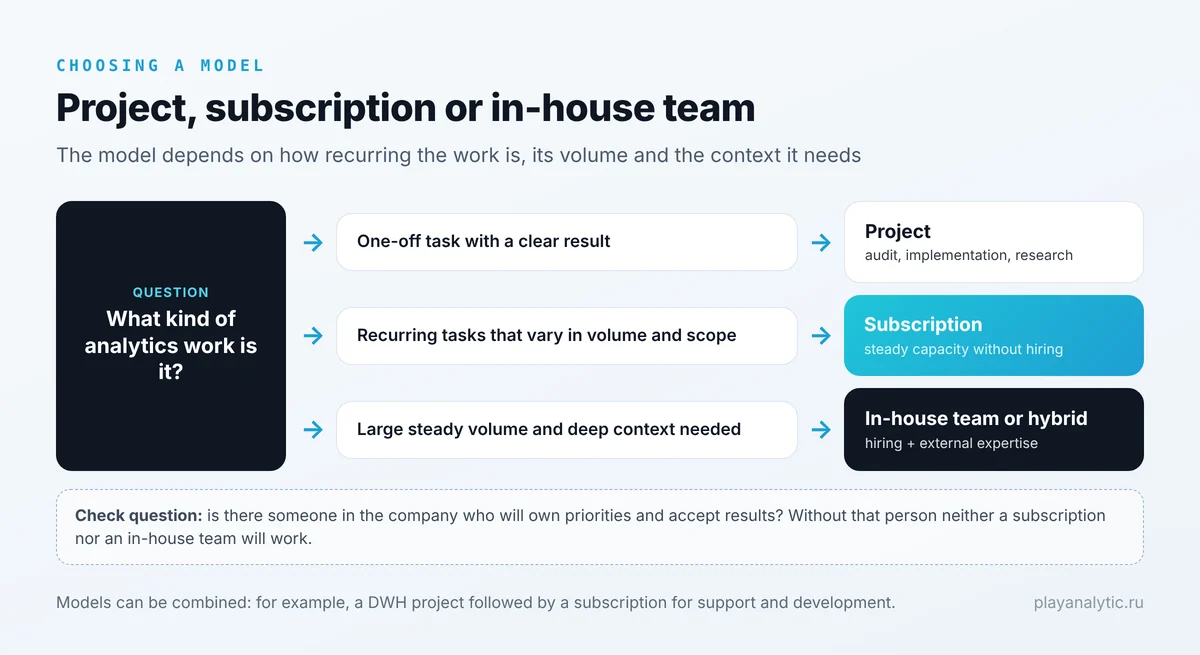
A subscription is useful when analytics work recurs but does not yet justify hiring every capability in-house. Typical needs include maintaining BI, monitoring data pipelines, answering product questions, supporting marketing analysis, improving warehouse models and reviewing analytical methods.
The work often changes from month to month. One period may require research and segmentation, another may need a source integration or reporting change, and the next may involve testing a product hypothesis. A single employee may not cover the required mix of skills, while separate project contracts make continuity and knowledge transfer harder.
An external team can complement a small internal function. For example, an in-house product analyst may retain deep knowledge of the game or service while the provider contributes data engineering, senior review or specialist modelling. It is less appropriate for a rare, tightly scoped task such as a one-off audit or a single migration. It is also unlikely to solve a problem if nobody inside the company can own priorities or act on the conclusions. A provider can organise delivery, but cannot create business accountability on the client’s behalf.
What work should the service catalogue include?
A service catalogue clarifies which recurring activities are covered and what the client should receive. Separate operational support from analytical investigations and larger projects so that the subscription does not become an undefined queue.
Useful categories include data operations, BI support, analytical research and expert oversight. Data operations may cover pipeline monitoring, quality checks and small source changes. BI support may cover marts, dashboards and user questions. Analytical research may include segmentation, funnel analysis and hypothesis testing. Expert oversight may cover architecture, methodology, prioritisation and quality review.
Define the entry conditions for each category. An analysis request should have a business question, audience, time period and decision owner. A reporting defect should include the expected and observed behaviour. A new integration may need a separate estimate if it changes architecture or requires significant source work.
For each output, define what “done” means. A report may need a documented metric definition and a named owner. An investigation may need a written conclusion, limitations and recommended next step. A pipeline change may need tests, monitoring and a handover note. The service should be evaluated on usable outcomes rather than the number of tickets closed.
How should capacity and service expectations be agreed?
Capacity should be linked to the likely workload, roles and service priorities. Monthly hours can help plan availability, but do not describe the value or guarantee that every request will be completed immediately.
Agree the amount of capacity, working calendar, availability, planning cycle and treatment of unplanned work. Define incident severity, response windows, escalation routes and who can approve a priority change. If the same team delivers projects and supports production pipelines, protect enough capacity for incidents rather than assuming all time is available for planned development.
Use a shared backlog with clear states: submitted, needs clarification, estimated, prioritised, in progress, waiting for client input, delivered and accepted. The client should see why an item is delayed and what result is expected next. A monthly plan should make trade-offs visible instead of promising that everything will fit.
Set boundaries for work that is not included. A major migration, a new enterprise system, a large historical backfill, out-of-hours response or a new data domain may need separate scoping. ## How should responsibility be split between client and provider?
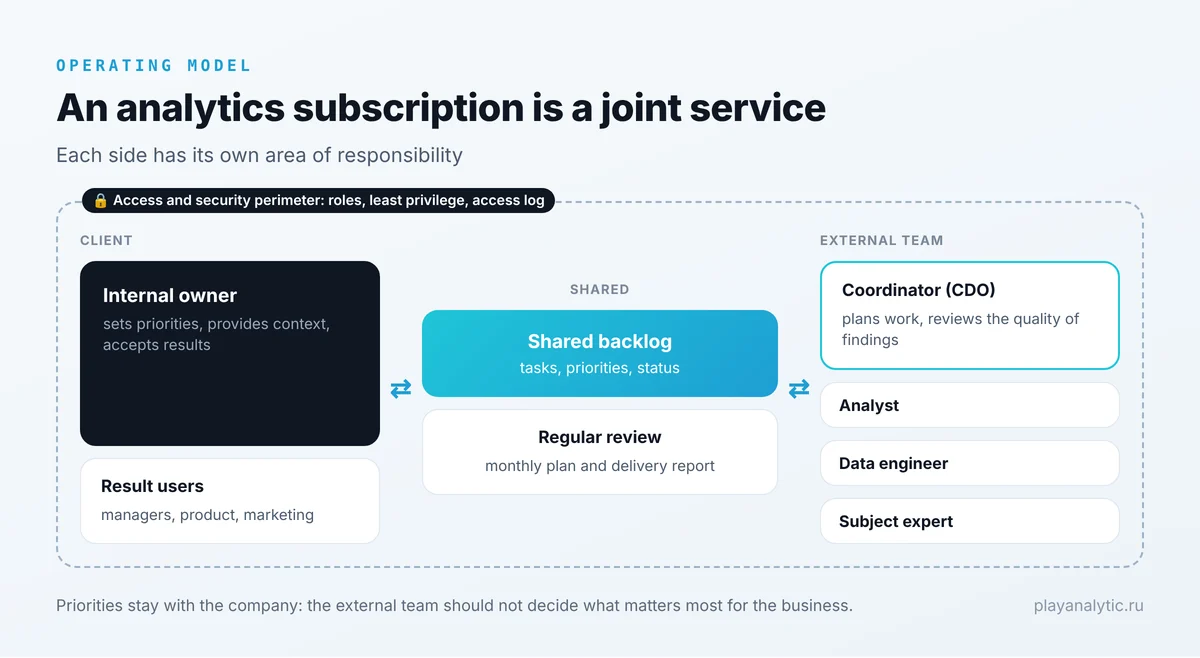
The client and provider should distinguish delivery responsibility from business ownership. The provider may build models, conduct analysis, document work and run agreed quality checks. The client owns business priorities, legal authority to share data and the decisions made using the output.
A RACI matrix can clarify who is Responsible for doing the work, Accountable for the result, Consulted and Informed. Assign a business owner on the client side and a delivery owner on the provider side for each service category. Avoid a situation where several departments submit conflicting requests but nobody can decide which takes precedence.
Access should follow least-privilege principles. Record which environments can be used, how credentials are shared, whether data can be copied, where extracts are stored and how access is revoked. Sensitive data may need masking, pseudonymisation or other controls agreed with the client’s security and legal owners.
Knowledge transfer should be part of delivery. Code, models, metric definitions, runbooks and decision records should be held in a shared location that the client can access. A subscription should not depend on undocumented knowledge kept in an individual contributor’s chat history.
How should provider performance be assessed?
Assess the reliability and usefulness of the service, not just the number of hours consumed. Fast delivery has limited value if conclusions need repeated correction or never influence a decision.
Potential indicators include backlog age, response performance against agreed service levels, recurring incidents, acceptance quality, documentation coverage and feedback from internal stakeholders. Interpret them together. A shorter average completion time may simply mean the team is selecting easier requests, while complex work remains blocked.
Run a periodic service review. Identify repeated requests that could be automated, reports that are no longer used, data-quality issues that should be fixed at source and analytical questions that need better business framing. Review scope as the business changes rather than automatically increasing capacity every time the backlog grows.
A good provider is transparent about uncertainty and constraints. If a conclusion relies on incomplete data or a non-experimental comparison, that limitation should be visible before a business decision is made. Quality control is not only code review; it also includes method, interpretation and communication.
When should the company build an in-house team?
An internal team may be more effective when demand is consistently high, product context is needed every day, close interaction with engineering is essential or the work requires immediate access to internal stakeholders.
Signals include a subscription that is fully occupied by recurring work, a high share of tasks that depend on undocumented product knowledge, a growing need to develop internal skills and a workload that approaches the cost of permanent roles. Compare total cost rather than the provider fee with one employee’s salary. In-house costs include recruitment, payroll overhead, equipment, management, training, retention and cover during absence. Subscription costs include provider capacity, vendor management, context transfer and dependency risk.
The transition does not need to be abrupt. An external team may continue to provide rare expertise or support the platform while internal hires build experience. The client should progressively own critical metrics, data access, product context and prioritisation.
A practical analytics subscription checklist
Use this checklist before committing to a recurring model.
| Area | What to agree | Question to resolve |
|---|---|---|
| Service catalogue | Included and excluded work | Which activities require separate scoping? |
| Capacity | Roles and available time | How is unplanned work handled? |
| Priorities | Backlog owner and approval | Who can reorder requests? |
| SLA | Response and escalation | What counts as an incident? |
| Acceptance | Definition of done | Who confirms the output is usable? |
| Security | Access, storage and transfer | How are permissions revoked? |
| Documentation | Repositories and runbooks | Can the client continue independently? |
| Review | Frequency and decision criteria | When should the model change? |
How is PlayAnalytic’s subscription structured?
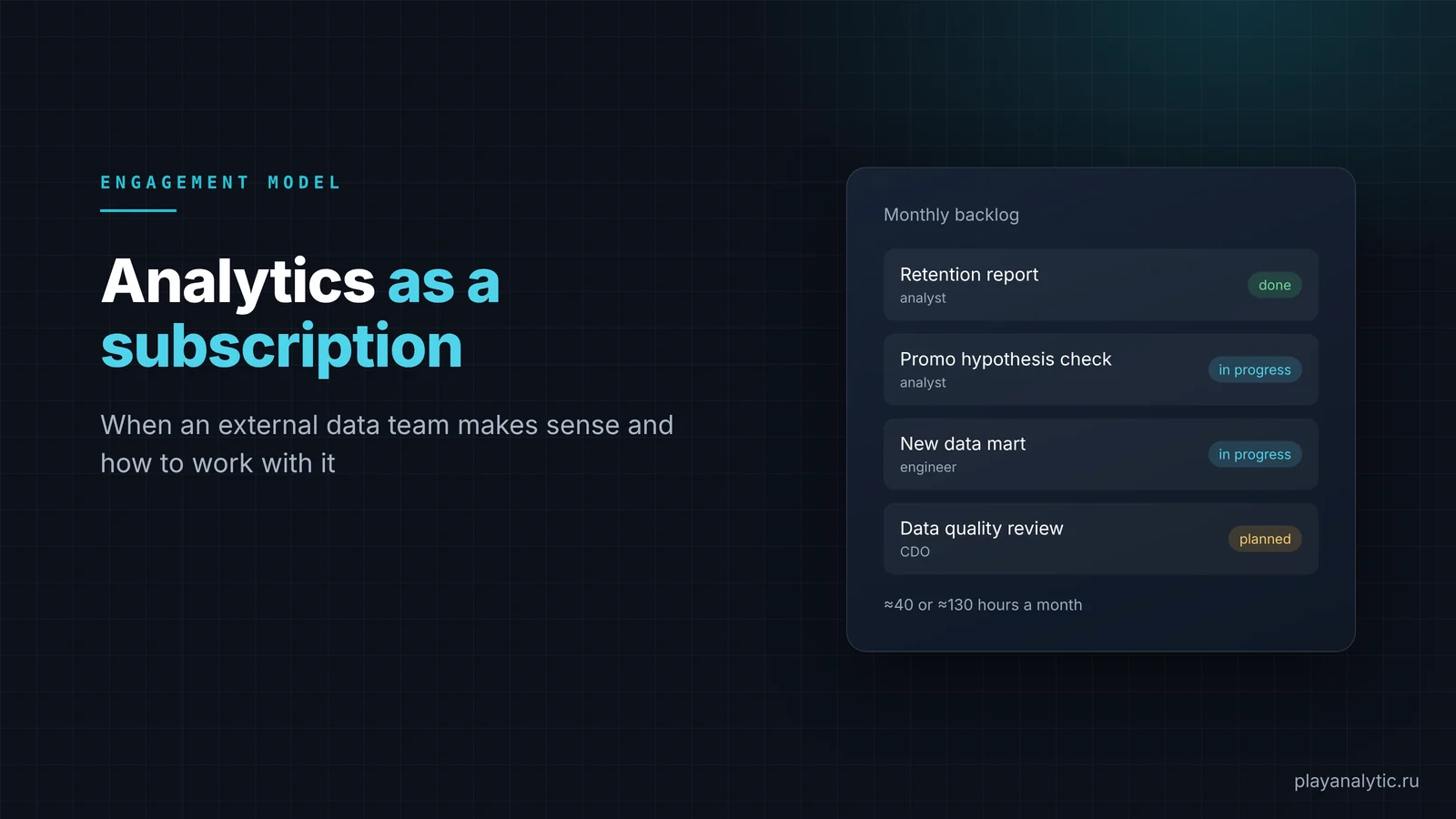
We offer two options: a senior analyst for about 40 hours a month, or a team (product and marketing analysts, a data engineer and a CDO) for about 130 hours a month. The minimum term is three months, and a data director reviews the quality of the findings. The exact setup is matched to your tasks.
This model may suit companies that need recurring analysis and data-platform support but are not ready to recruit a full range of roles. Before work begins, agree the service catalogue, owners, access, backlog priorities and acceptance criteria. See Analytics Subscription.
FAQ
Can a company subscribe for only a small amount of analyst time?
That depends on the provider's available formats and the workload. The important question is whether the capacity is large enough to complete meaningful tasks after context switching and coordination. A very small allocation may provide access but not enough continuity to deliver an outcome.
Who should submit requests to the external team?
The client should appoint a coordinator or service owner who gathers needs and prioritises the shared backlog. Departments can still contribute requests, but one accountable person should resolve conflicts and confirm the order of work.
How can the client avoid losing knowledge when provider staff change?
Keep code, metric definitions, runbooks and decision records in shared repositories. Include handover requirements in the service agreement and review documentation as part of acceptance. Important knowledge should not remain only in private messages or individual memory.
Does an analytics subscription guarantee business results?
No. The provider can be accountable for agreed delivery quality and service expectations, but business outcomes also depend on source data, client decisions, implementation and external conditions. Define service measures separately from the way business impact will be assessed.