Analytics Maturity Audit: How to Decide What to Improve First
A practical way to assess decision support, metrics, data foundations, BI, teams and governance before committing to analytics investment.
Key takeaways
- Analytics maturity is the organisation’s ability to use data consistently in decisions, not the sophistication of its technology stack.
- A useful review covers nine connected areas, from business alignment and metrics to architecture, people and risk management.
- Scores should be supported by interviews, artefacts and sample checks. A rating without evidence creates false confidence.
- The final output should be a sequenced roadmap with owners, dependencies, effort ranges and acceptance criteria.
- The best starting point is usually a small number of important decisions, not a company-wide platform replacement.
An organisation rarely has a single analytics problem. It may have a capable BI team but no agreed definition of revenue, a modern warehouse with fragile source integrations, or a strong analyst whose work is disconnected from the decisions executives make. An analytics maturity audit makes these dependencies visible. Its purpose is not to award a score. It is to help leaders decide where to invest, what to stop doing and who should own the next change.
What does analytics maturity mean to the business?
Analytics maturity describes how reliably an organisation turns data into decisions and actions. It is an operating capability rather than a technology ranking.
A company can run a sophisticated cloud platform and still struggle to answer a basic margin question because finance and commercial teams use different definitions. Another company may rely on a modest warehouse but have clear metric ownership, documented models and a predictable process for resolving data issues. The second organisation may be more mature for its current needs.
Start with decisions that matter. Ask executives and functional leaders which recurring choices are difficult because information is late, inconsistent or hard to interpret. Examples include allocating acquisition spend, understanding product profitability, forecasting demand, identifying customer risk or planning operational capacity. Follow each decision backwards: which metric informs it, where does that metric come from, who approves its definition and how does the organisation act on it?
This approach separates data availability from decision readiness. A source may exist but lack reliable history. A dashboard may refresh but arrive after the meeting where it is needed. A model may produce a score without an owner who can act on it. These are maturity gaps even when the technology is working as designed.
There is no universal maturity benchmark that makes one score meaningful across every company. The assessment should reflect the organisation’s size, operating model, risk and strategic priorities. Its value is the shared picture it creates, not a league-table position.
Which nine areas belong in the assessment?
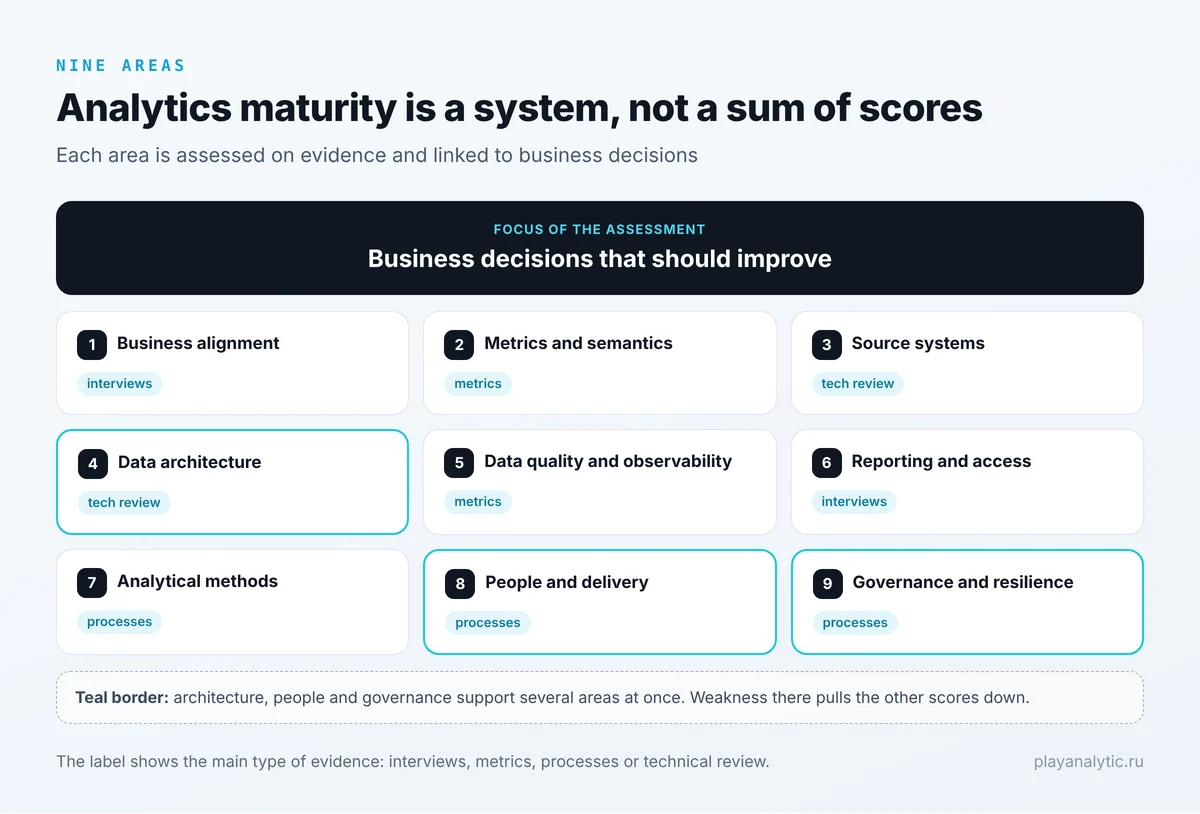
A practical audit examines nine domains. They are distinct enough to assess, but connected enough that a weakness in one area can limit investment in another.
- Business alignment. Are priority decisions and use cases explicit? Does each have a business owner and a reason to invest?
- Metrics and semantics. Are important measures defined consistently, including grain, time window, exclusions and ownership?
- Source systems. Are critical sources known, accessible and understood? Are refresh delays and manual dependencies visible?
- Data architecture. Do the warehouse, pipelines and models fit the workload without unnecessary complexity or unmanaged risk?
- Data quality and observability. Are freshness, completeness, validity, uniqueness and reconciliation tested? Is there a response process when a check fails?
- Reporting and access. Do reports support recurring decisions, and can users understand the meaning and limitations of the figures?
- Analytical methods. Does the team use cohorts, forecasting, experimentation or causal analysis where appropriate, with assumptions stated?
- People and delivery. Are roles, skills, priorities, documentation and request-management routines clear?
- Governance and resilience. Are permissions, sensitive data, retention, backup and change controls managed?
How can an audit distinguish evidence from opinion?
A credible audit triangulates what people say with what the organisation actually does. Interviews alone are not enough: a process may be described as standardised while analysts still repair spreadsheets manually before every reporting cycle.
Interview the owners of important decisions, finance, product, marketing, operations, engineering and the analytics team. Ask about recent examples rather than abstract maturity. When did a metric create disagreement? How long did it take to establish the cause? Who approved the correction? Was the same problem seen again?
Review artefacts that reveal operating behaviour: metric catalogues, data-flow diagrams, dashboards, access policies, incident logs, backlogs, model documentation and change records. Then choose a small set of critical KPIs and trace them from source to consumption. Include an ordinary period and a period with a correction, release or unusual operating condition.
Record the evidence behind each conclusion. For example: “The active-customer formula is documented in the BI model, but the web and mobile teams use different event rules and no owner approves changes.” This statement identifies a specific gap and a possible action. “Metric maturity: 2.5 out of 5” does not.
Separate confirmed weaknesses from unanswered questions. Missing documentation is evidence of a documentation gap, but it does not automatically prove that the data itself is wrong. Where access is restricted or a source cannot be inspected, state the limitation and include a follow-up check in the roadmap.
How should findings become an investment roadmap?
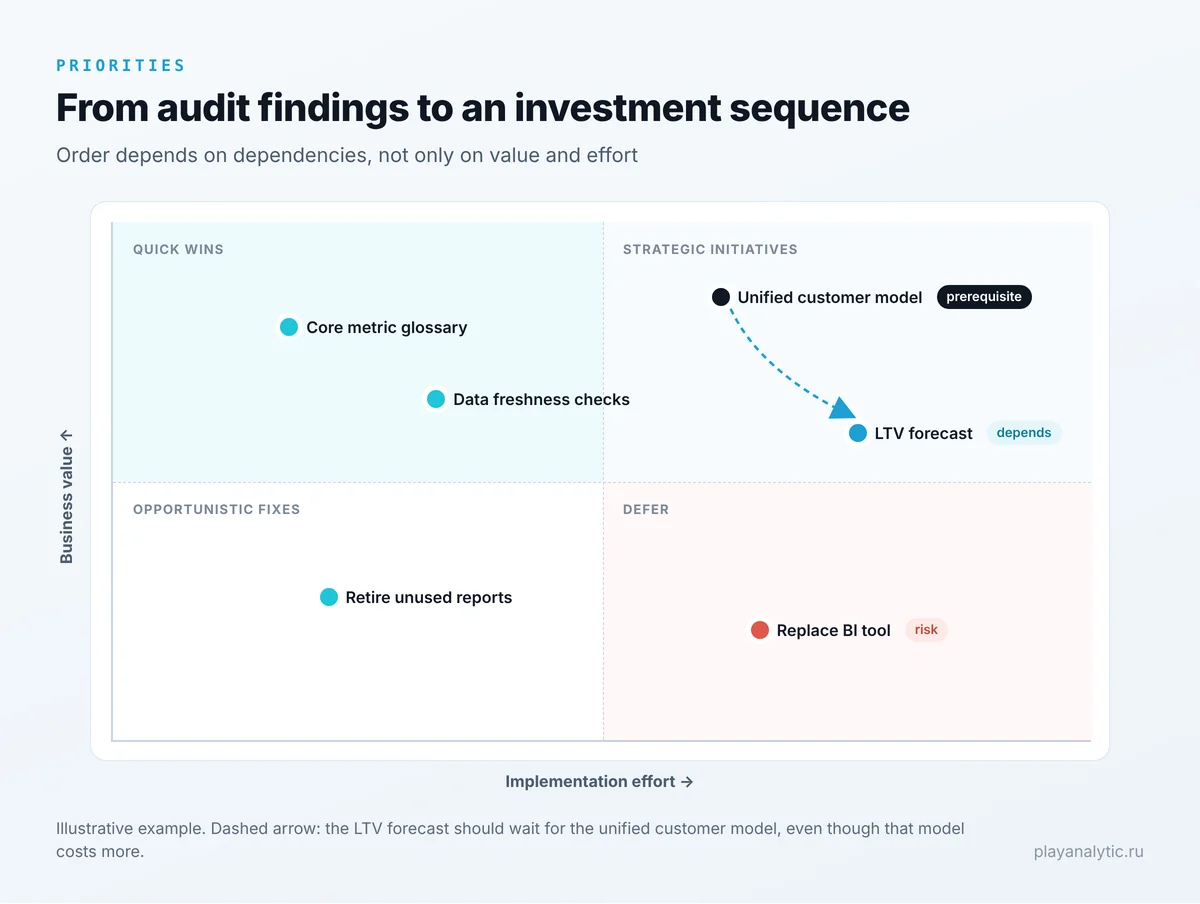
Priorities should reflect business impact, exposure if nothing changes, implementation effort and dependencies. The lowest-scoring domain is not automatically the first project: a weak capability may be irrelevant to current priorities, while a moderate issue in a board-level financial dataset may carry substantial risk.
A useful portfolio separates urgent controls, foundational improvements and new capabilities. Metric ownership may be a quick prerequisite for a reporting project. Source reliability may need to be addressed before a forecasting model can be trusted. A platform migration can be justified when current constraints block several important use cases, but not simply because a different tool is fashionable.
For each initiative, specify a business owner, technical owner, expected artefact, acceptance criteria, dependencies and a way to observe the outcome. Use ranges for effort and cost when scope is uncertain. Show assumptions rather than presenting an early estimate as a fixed promise.
Sequence the roadmap around the work that unlocks other work. A reporting layer should not be signed off before its KPI definitions are approved. A predictive model should not be scaled before historical depth, population bias and outcome availability have been assessed. This makes the roadmap a decision tool rather than a list of disconnected improvements.
What scoring model is useful without false precision?
A four-stage rubric is often enough to create a consistent discussion. It is a working scale, not an industry certification or a substitute for evidence.
| Stage | Observable practice | Business implication |
|---|---|---|
| 0. Undefined | No agreed owner or repeatable process | Results depend on individual knowledge and informal workarounds |
| 1. Reactive | Work is performed after issues appear | Delivery and quality are difficult to predict |
| 2. Repeatable | Documented steps exist and are used regularly | Outcomes are reproducible, but control may be incomplete |
| 3. Managed | Ownership, quality measures and review routines are active | Teams can detect deterioration and manage improvement |
Imagine that an organisation is assessing metric governance. If formulas live in individual queries, the practice may be reactive. If a catalogue exists, owners approve changes and downstream reports are updated through a defined process, it may be managed. The auditor still needs to test whether teams use the catalogue in real work.
Avoid collapsing all nine domains into a single average. A high score in BI adoption can conceal a critical weakness in access management or financial semantics. A profile with evidence, confidence levels and risk notes is more useful than one headline number.
When is an independent audit worth commissioning?
An external review is useful when leaders need an impartial view across departments or a defensible basis for investment. Common triggers include a planned warehouse migration, a growing analytics function, persistent disagreements about metrics or a data programme that has not produced the expected operational change.
An independent team can structure interviews, inspect representative source-to-report paths, challenge architectural assumptions and translate findings into a roadmap. It cannot replace internal ownership. Without access to decision-makers and real workflows, the review becomes a document assessment rather than a reliable picture of the operating model.
Our maturity audit takes two to three weeks: we assess analytics across nine areas, identify the three most critical gaps with an estimate of effort and impact, review the architecture and prepare a roadmap for 90, 180 and 365 days. The scope is tailored to your starting point. If you also need someone to lead the roadmap, see our guide to the Interim CDO role.
FAQ
How long does an analytics maturity audit take?
It depends on the number of business areas, source systems, stakeholders and the depth of technical inspection. A focused review can examine a small set of critical decisions and data flows. A multi-entity organisation may need a broader programme. Agree on the questions, sample and expected outputs before setting a schedule.
Should all nine domains receive equal attention?
No. All nine should be considered, but the depth should follow business risk. A warehouse migration calls for more attention to architecture, source contracts, history and operations. A disagreement about management KPIs calls for deeper work on semantics, ownership and reconciliation.
Can the audit select a BI tool for us?
It can define requirements and a shortlist, but tool selection should follow an understanding of use cases, users, sources, security and total cost of ownership. The right recommendation may be to improve the existing platform rather than replace it.
What if executives disagree with the audit rating?
Review the evidence, assumptions and confidence level behind the conclusion. Invite the relevant owner to validate the example and identify what additional information could change the assessment. The objective is a transparent basis for action, not agreement with a score for its own sake.